
Why Genomics Lab Furniture Requires a Specialized Approach
Genomics lab furniture has to satisfy a set of demands that general-purpose casework simply was not built to handle. Next-generation sequencing (NGS) workflows involve ultra-sensitive detection of nucleic acids, which means even trace contamination from a previous sample or an adjacent workflow can compromise results.
Unlike a general chemistry lab where a small amount of cross-contamination might introduce measurement error, genomics work can produce entirely false results from contamination levels too small to see or smell. This raises the stakes for every furniture and layout decision, from bench material to airflow pattern.
Labs standing up new sequencing capacity, or retrofitting existing space for genomics work, need furniture systems purpose-built for nucleic acid workflows. The team at Genie Scientific specializes in translating genomics protocols into concrete furniture and layout specifications that protect sample integrity at every step.
NGS Lab Design: Workflow Zoning Fundamentals
Effective NGS lab design starts with strict workflow zoning that separates pre-amplification, amplification, and post-amplification activities into physically distinct areas. This unidirectional workflow is the single most important design principle for preventing amplicon contamination, which can render sequencing runs unusable.
A well-zoned genomics lab guides both people and materials in one direction, from sample receipt through extraction, library preparation, amplification, and sequencing, without backtracking through cleaner zones. Furniture placement should reinforce this directional flow rather than leave it to verbal protocol alone.
For a comprehensive overview of how furniture selection supports genomics-specific workflows, see Essential Genomics Lab Furniture for Cutting-Edge Research.
- Pre-amplification zone: Dedicated benches and storage for sample receipt, nucleic acid extraction, and library preparation, isolated from amplified product.
- Amplification zone: PCR and qPCR instruments housed in a separate area with its own dedicated pipettes, consumables, and PPE.
- Post-amplification zone: Sequencing instruments and downstream analysis stations positioned as far from pre-amplification work as the floor plan allows.
- One-way material flow: Consumables and samples should move in a single direction through the zones, never crossing back into an earlier stage.
- Distinct color-coded equipment: Assign color-coded pipettes, lab coats, or bins to each zone so staff can immediately identify equipment that should never leave its designated area.
PCR Workstation Design and Contamination Control
A PCR workstation sits at the highest-risk junction in most genomics workflows, where trace amounts of amplified DNA can aerosolize and contaminate future reactions if the surrounding furniture and airflow are not carefully controlled.
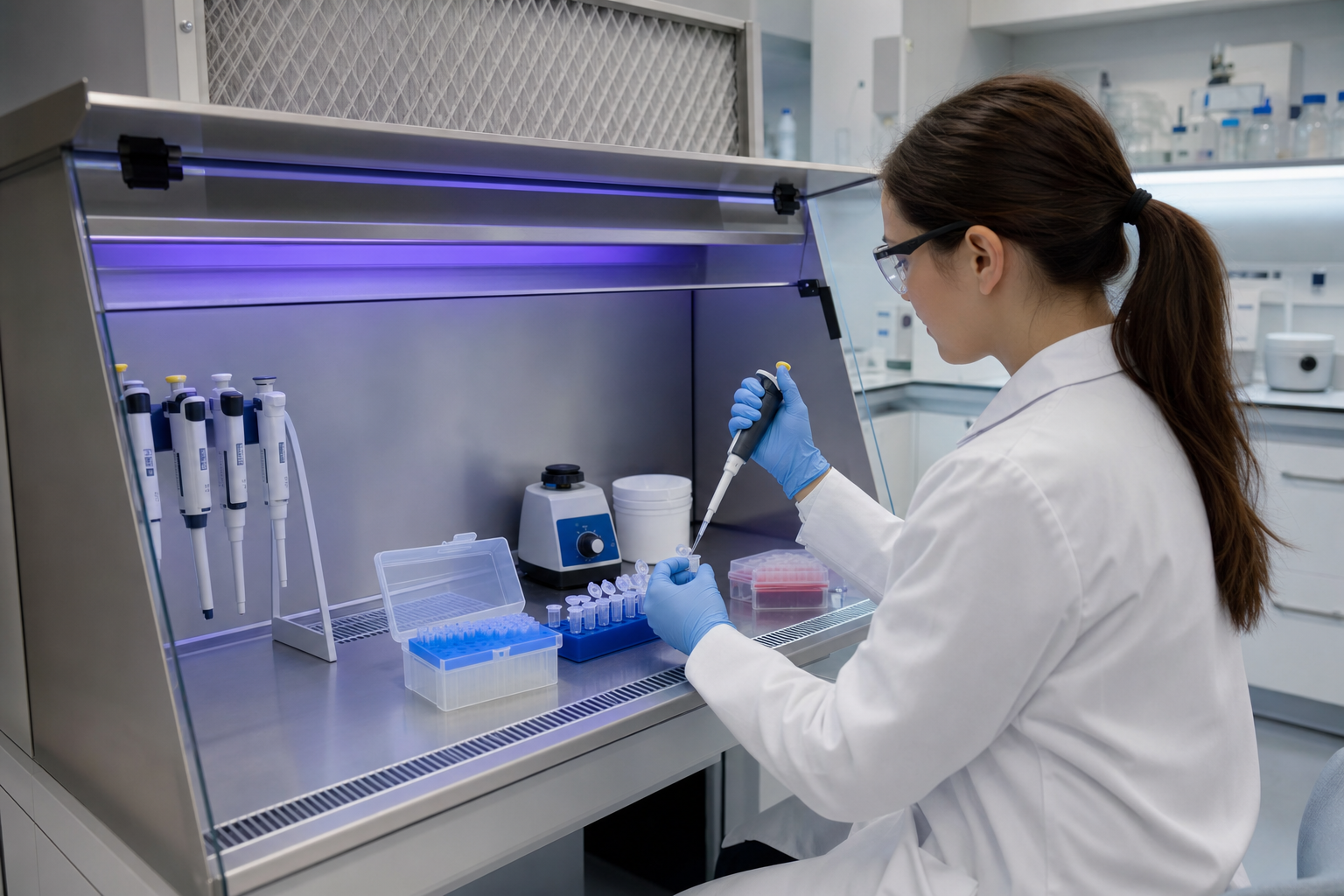
PCR workstations should be enclosed or hooded to contain aerosols, equipped with UV decontamination capability, and finished with materials that support frequent, aggressive cleaning between uses. The bench surface itself needs to resist not just chemical cleaners but the daily wear of pipetting, centrifuging, and sample handling.
- PCR enclosures with UV sterilization: Dedicated hoods or cabinets with built-in UV lamps decontaminate the work surface between sessions.
- Non-porous work surfaces: Epoxy resin or chemical-resistant laminate countertops resist nuclease contamination and stand up to bleach or ethanol wipe-downs.
- Segregated equipment storage: Pipettes, tip boxes, and reagents used at the PCR bench should never be shared with pre- or post-amplification zones.
- HEPA-filtered PCR cabinets: For high-throughput labs, HEPA-filtered enclosures add a layer of aerosol protection beyond standard hoods.
- Adequate bench spacing: Position PCR workstations with enough separation from high-traffic aisles to reduce the chance of accidental cross-contact during busy periods.
DNA Lab Benches: Material and Surface Considerations
DNA lab benches must balance chemical resistance, ease of decontamination, and ergonomic function. Genomics work involves frequent use of ethanol, bleach, and DNA-away style decontamination products, all of which can degrade lower-quality bench surfaces over time.
Epoxy resin countertops remain the gold standard for genomics benches because they resist nuclease and nucleic acid contamination while standing up to repeated aggressive cleaning. Stainless steel is another strong option, particularly in areas adjacent to automated liquid handling systems where spill resistance and easy sanitation matter most.
Sequencing labs increasingly integrate advanced instrumentation directly into bench design, which means furniture needs to support significant point loads, vibration dampening, and integrated utility access. Understanding how genomics furniture fits into the broader lab build is covered in depth in How to Design a Laboratory for Advanced Biotechnology Research.
- Epoxy resin countertops: Resist nuclease contamination and tolerate frequent bleach or ethanol decontamination without degrading.
- Vibration-dampened surfaces: Sequencing instruments and sensitive detection equipment benefit from benches engineered to minimize vibration transfer.
- Integrated utility access: Built-in power, data, and vacuum lines reduce cable clutter around sensitive instrumentation.
- Rounded, seamless edges: Coved bench edges and backsplashes prevent contamination from accumulating in corners and seams.
- Adjustable-height options: Sequencing lab benches that accommodate both seated pipetting work and standing instrument operation improve ergonomics across mixed workflows.
Sequencing Lab Layout for High-Throughput Facilities
Sequencing lab layout planning becomes more complex as facilities scale from a single sequencer to high-throughput operations running multiple instruments in parallel. Layout decisions at this scale affect not just contamination control but also sample tracking, staff efficiency, and instrument uptime.
High-throughput genomics facilities benefit from a hub-and-spoke layout, where a central sample intake and tracking station feeds outward into parallel processing lanes. This design keeps sample chain-of-custody clear while allowing multiple technicians to work simultaneously without colliding in shared space.
Cross-contamination risk multiplies as throughput increases, making furniture-level safeguards even more critical at scale. For strategies specific to preventing contamination through smart furniture choices, review Cross-Contamination Lab Safety Through Smarter Furniture Design.
- Hub-and-spoke sample flow: Centralize intake and tracking, then distribute samples outward into parallel, physically separated processing lanes.
- Instrument-specific bench pads: Sequencers often require vibration isolation pads or dedicated bench sections rated for their specific weight and footprint.
- Dedicated cold storage proximity: Position freezers and cold storage adjacent to processing lanes to minimize sample transport time and temperature excursion risk.
- Scalable modular casework: Choose furniture systems that can add processing lanes as sequencing volume grows without a full lab redesign.
Air Handling and Environmental Controls for Genomics Labs
Furniture and layout alone cannot fully control contamination without matching air handling systems. Genomics labs benefit significantly from directional airflow that moves from clean zones toward less-clean zones, reinforcing the same one-way logic applied to workflow zoning.
Positive pressure in pre-amplification and library prep areas helps keep ambient contaminants out, while slightly negative pressure in post-amplification zones helps contain any aerosolized amplicons. These pressure relationships need to be engineered alongside furniture placement, not bolted on afterward.
Temperature and humidity stability also matter more in genomics labs than many facilities managers initially expect, since reagent stability and enzymatic reactions used in library preparation are sensitive to environmental swings.
- Directional airflow: Design HVAC to move air from clean to less-clean zones, reinforcing physical workflow separation.
- Pressure differentials: Positive pressure in prep areas and negative pressure in amplification zones limit contaminant movement between spaces.
- HEPA filtration at key transitions: Filtered air supply at zone boundaries adds another layer of contamination control beyond furniture and workflow design.
- Humidity and temperature monitoring: Continuous environmental monitoring protects reagent stability and instrument performance.
Planning Your Genomics Lab Furniture Investment
Genomics lab furniture decisions should be driven by your specific sequencing platforms, sample volumes, and contamination risk tolerance rather than generic lab furniture catalogs. A furniture plan built around your actual workflow prevents costly rework once instruments arrive and researchers discover the layout does not support their protocols.
Start by mapping every step of your genomics workflow from sample receipt to final data output, noting where contamination risk is highest and where instruments will physically sit. This workflow map should drive zoning, bench material selection, and utility routing decisions before any furniture is ordered.
Partnering with a furniture provider that understands genomics-specific requirements, like Genie Scientific, ensures your lab is built around the realities of NGS work rather than retrofitted after the fact. The right genomics lab furniture protects both your sample integrity and your research timeline.
As sequencing technology continues to evolve, furniture systems that offer modularity and adaptability will serve your lab better than fixed, single-purpose casework. Build for the workflow you have today, but choose furniture that can flex as your genomics program grows.