
The Hidden Cost of Overlooking Ergonomic Lab Design
Ergonomic lab design is often treated as a nice-to-have, addressed only after safety incidents or worker complaints pile up. That reactive approach is expensive. Musculoskeletal injuries from repetitive pipetting, awkward reaching, and prolonged standing rank among the most common and most preventable causes of lost research time in laboratory settings.
Researchers spend long hours in fixed postures, performing repetitive fine-motor tasks under time pressure. Without deliberate ergonomic planning, this combination produces chronic strain injuries that reduce productivity long before they become visible as workers’ compensation claims or absenteeism.
Lab managers who invest in ergonomic lab design upfront see measurable returns: fewer injury-related absences, faster task completion, and higher-quality data from researchers who are not distracted by discomfort. The specialists at Genie Scientific work with facilities teams to build ergonomics into furniture selection from the start rather than retrofitting it after problems emerge.
Common Sources of Laboratory Ergonomics Risk
Before selecting furniture or redesigning a workspace, it helps to understand exactly where laboratory ergonomics risks originate. Most injury patterns in research environments trace back to a small set of repeated, predictable hazards.
Identifying these risk factors in your own facility is the first step toward a targeted ergonomic lab design strategy rather than a generic furniture upgrade that misses the real problem.
- Fixed-height benches that force shorter or taller researchers into awkward shoulder, neck, or back positions during extended procedures.
- Repetitive pipetting motions that strain the thumb, wrist, and forearm, a leading cause of researcher fatigue and repetitive strain injury in wet labs.
- Prolonged standing on hard flooring without cushioning, leading to lower back, knee, and foot pain over full shifts.
- Poorly positioned monitors and keyboards at data analysis stations that force awkward neck angles and wrist extension.
- Overhead reaching for supplies or equipment stored above shoulder height, increasing shoulder strain and dropped-item hazards.
- Inadequate task lighting that causes researchers to lean or hunch closer to their work to compensate for poor visibility.
Height-Adjustable Furniture as the Foundation of Ergonomic Lab Design
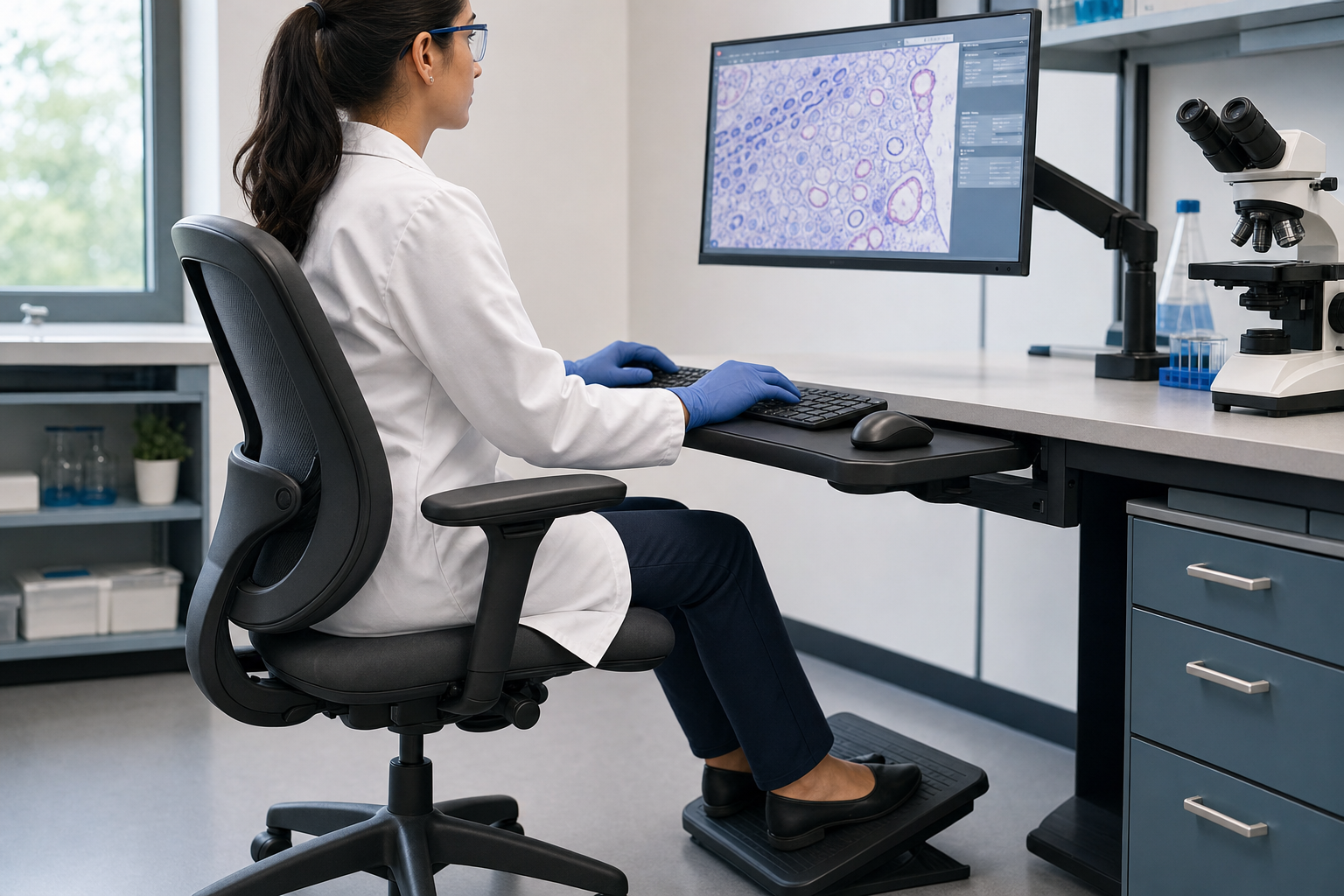
No single furniture upgrade delivers a bigger ergonomic return than height-adjustable benching. Static-height benches force a compromise that fits no one perfectly, since researcher heights in any facility can vary by more than a foot. Height-adjustable systems let each person set the work surface to their optimal elbow height, whether seated or standing.
Sit-stand capability also addresses a second major ergonomic risk: prolonged static posture. Alternating between sitting and standing throughout a shift improves circulation, reduces lower back fatigue, and has been shown to improve alertness during long analytical procedures.
For a closer look at how adjustable benching translates into measurable comfort and output gains, see Height-Adjustable Lab Benches: Improving Comfort and Productivity.
- Electric height-adjustable benches allow quick, tool-free transitions between sitting and standing heights, ideal for shared workstations used by multiple researchers.
- Manual crank or pneumatic systems offer a lower-cost alternative for labs with stable staffing and less frequent need for mid-shift adjustments.
- Programmable height presets let researchers save their preferred settings and return to them instantly at shared or rotating stations.
- Adjustable-height benches should be paired with matching adjustable stools or chairs to maintain proper elbow and knee angles at any bench height.
Seating, Standing Surfaces, and Anti-Fatigue Solutions
Chairs and standing surfaces are just as important as the bench itself in a comprehensive ergonomic lab design strategy. Generic office seating rarely holds up to lab conditions, and it almost never provides the postural support researchers need during long procedures.
Purpose-built lab seating incorporates chemical-resistant, cleanable upholstery along with the adjustability features that reduce strain: seat height, tilt, lumbar support, and armrest position. The considerations behind selecting the right seating for extended bench work are detailed in Ergonomic Lab Seating: Reducing Fatigue in Long Research Hours.
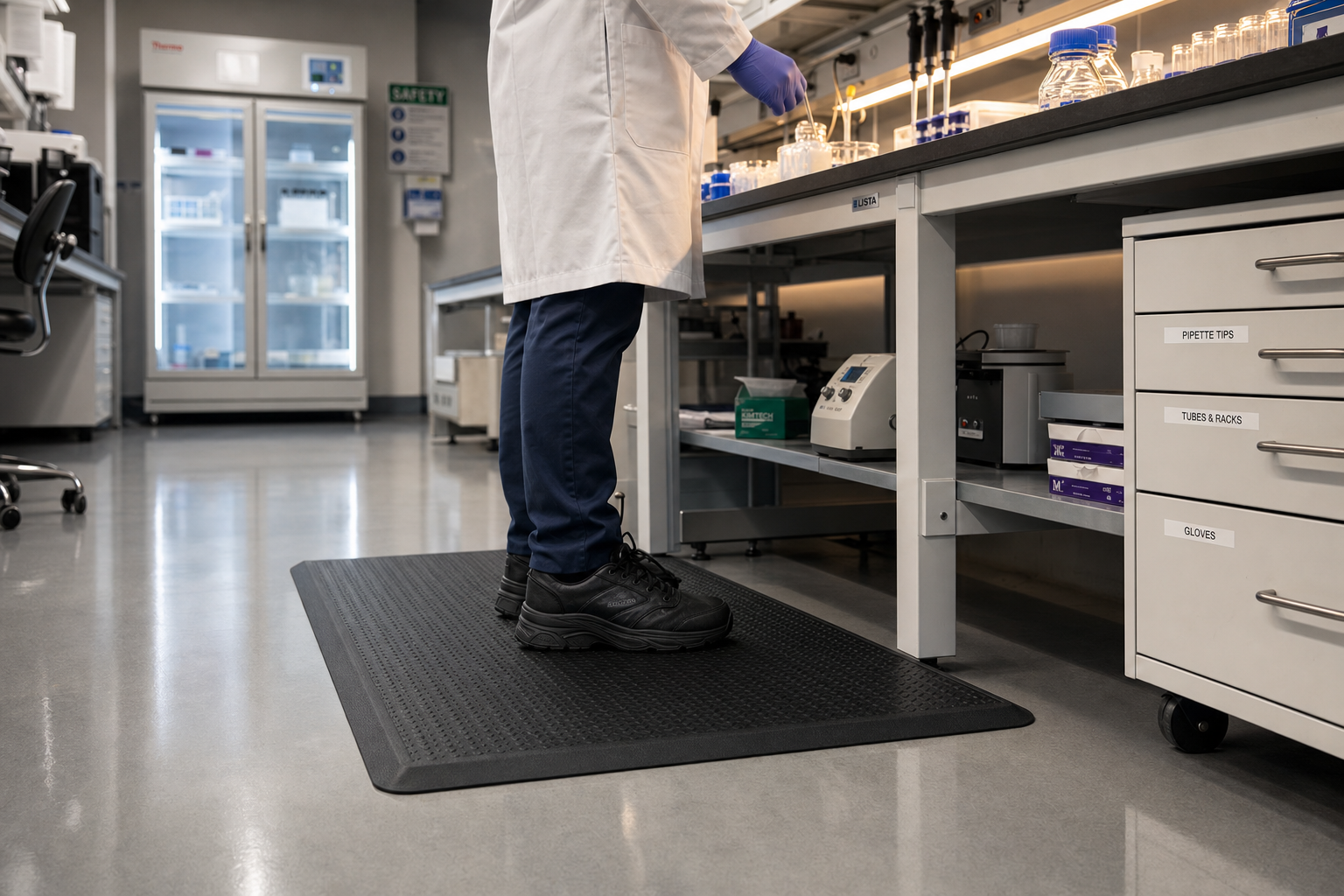
For researchers who stand for extended periods, flooring matters as much as furniture. Standing on hard tile or concrete for hours contributes significantly to lower back and leg fatigue, and this is one of the simplest ergonomic problems to solve. The guidance in Anti-Fatigue Lab Mats: Enhancing Safety, Comfort, and Productivity in Laboratories explains how cushioned, chemical-resistant matting reduces fatigue without compromising lab safety standards.
- Pneumatic seat height adjustment allows quick changes between users without tools, essential for shared bench stations.
- Waterfall seat edges reduce pressure on the back of the thighs, improving circulation during long seated procedures.
- Anti-fatigue mats with beveled edges prevent trip hazards while still delivering cushioning benefits at standing workstations.
- Mats used in wet lab or chemical handling areas should be non-porous and chemical-resistant to avoid becoming a contamination or slip hazard themselves.
Layout and Reach Zones: Reducing Strain Through Smart Planning
Furniture selection solves part of the ergonomic equation, but layout determines how much researchers actually have to stretch, twist, or bend during a typical task sequence. Ergonomic lab design must account for reach zones just as carefully as it accounts for seating and bench height.
The principle of placing frequently used items within the primary reach zone, and reserving overhead or under-counter storage for infrequently accessed supplies, dramatically reduces repetitive strain over the course of a shift.
- Primary reach zone (within 18 inches of the body without bending or stretching) should hold instruments, tools, and materials used multiple times per hour.
- Secondary reach zone (18 to 24 inches, may require a slight lean) is appropriate for items used a few times per shift.
- Overhead storage above shoulder height should be reserved for lightweight, infrequently accessed supplies only, never for heavy equipment or daily-use materials.
- Rotating or lazy-susan style shelving at corner workstations reduces twisting motions needed to access supplies stored at awkward angles.
- Pull-out shelves and drawers at working height eliminate the need to bend down to floor-level cabinets for frequently used items.
Equipment and Tool Selection for Repetitive Task Reduction
Beyond furniture and layout, the tools researchers use every day carry significant ergonomic weight. Pipetting alone accounts for a large share of reported repetitive strain injuries in wet labs, making tool selection a critical piece of any researcher fatigue reduction plan.
Electronic and low-force pipettes reduce the thumb and wrist strain associated with manual repeater pipettes, particularly for researchers performing hundreds of repetitions per day. Similar ergonomic upgrades are available across most categories of frequently handled lab equipment.
- Electronic pipettes with programmable dispensing reduce the repetitive thumb force required by traditional manual models.
- Lightweight instrument housings and ergonomic grips reduce forearm fatigue during extended microscopy or handling tasks.
- Articulating monitor arms at data stations let researchers position screens at eye level, reducing neck strain during analysis work.
- Voice-activated or foot-pedal controls for certain instruments can eliminate awkward hand positions needed to operate switches mid-procedure.
Building an Ergonomics Program, Not Just an Ergonomic Room
Furniture and equipment upgrades deliver the greatest value when paired with an ongoing ergonomics program rather than treated as a one-time purchase. Training, periodic assessment, and a clear feedback channel for researchers to report discomfort keep ergonomic lab design effective as teams and tasks change over time.
Simple, low-cost measures like posture training and stretch breaks complement the furniture investment and extend its benefits across the full research team.
- Conduct periodic ergonomic assessments as new equipment, procedures, or staff join the lab, since needs shift over time.
- Train new researchers on proper bench height, chair adjustment, and reach zone principles during onboarding.
- Establish a simple reporting process for early discomfort so adjustments happen before minor strain becomes a chronic injury.
- Rotate repetitive tasks among team members where possible to limit any one person’s cumulative exposure to strain-heavy procedures.
Making the Business Case for Ergonomic Lab Design
Ergonomic lab design pays for itself through reduced injury claims, lower turnover, and measurable gains in researcher output. Facilities that treat ergonomics as core infrastructure rather than an optional upgrade consistently report fewer lost workdays and higher-quality experimental results.
The most effective approach combines height-adjustable benching, proper seating, anti-fatigue flooring, thoughtful reach-zone layout, and ergonomically designed tools into a single, coordinated furniture strategy rather than piecemeal fixes.
If your facility is planning a renovation or new build, involve an ergonomics-focused furniture partner early in the process. Genie Scientific helps lab managers and facilities planners specify benching, seating, and flooring solutions that reduce injury risk while supporting the demanding pace of modern research.
The labs that get ergonomic design right do not just avoid injuries. They build an environment where researchers can sustain focus and precision across long shifts, which shows up directly in the quality and consistency of the science they produce.