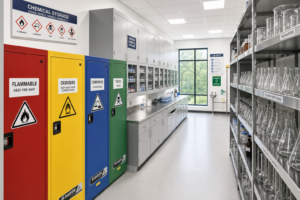

Cross-contamination is one of the most persistent safety concerns in laboratories, with the potential to compromise research integrity, endanger personnel, and violate compliance standards. That’s why cross-contamination lab safety is more than just a procedural checklist—it requires thoughtful planning of every aspect of the workspace.
In environments where precision and reliability matter most, even small lapses in contamination control can lead to costly errors.
While protocols and training are essential, the physical environment itself plays a critical role. Properly designed lab furniture helps create a safer, cleaner, and more efficient workflow by minimizing surfaces where contaminants can collect and by supporting hygienic practices.
From the choice of materials to the layout of workstations, smarter furniture design directly contributes to cross-contamination lab safety.
Understanding Cross-Contamination in Laboratories
Cross-contamination in laboratories occurs when unwanted substances—biological, chemical, or particulate—are introduced into a sample, workspace, or piece of equipment. These contaminants can spread through direct contact, airborne particles, or even human handling, making vigilance in cross-contamination lab safety an absolute priority.
Some of the most common sources include:
- Biological agents: transfer of microorganisms between cultures, test samples, or surfaces.
- Chemical residues: lingering solvents, reagents, or powders that migrate to unintended areas.
- Particulates and dust: microscopic particles settling on sensitive equipment or experiments.
- Human factors: improper handling, movement between stations, or inadequate hygiene practices.
The consequences of ineffective measures to ensure cross-contamination lab safety extend far beyond inconvenience. Research accuracy may be compromised, leading to invalid results.
Biosafety hazards can expose staff to harmful pathogens or toxic compounds. And from a regulatory standpoint, noncompliance with contamination control standards may result in fines, reputational damage, or project delays.
Recognizing these risks underscores why proactive strategies—including the integration of contamination-conscious furniture design—are vital to maintaining both scientific credibility and laboratory safety.

Lab Furniture as a First Line of Defense
When it comes to cross-contamination lab safety, lab furniture is often overlooked in favor of protocols and equipment. Yet, the physical environment can either amplify contamination risks or serve as a barrier against them.
The surfaces scientists work on, the storage systems they rely upon, and the layouts they move through every day all influence how effectively a lab can control contamination.
Poorly designed furniture introduces vulnerabilities: porous or cracked surfaces that trap contaminants, cluttered layouts that force cross-traffic between clean and hazardous areas, or inadequate storage that leads to accidental mixing of materials. Even with strict cleaning protocols, these design flaws create opportunities for contaminants to linger and spread.
Conversely, well-designed laboratory furniture acts as a preventative tool. Smooth, chemical-resistant surfaces reduce microbial harborage points, while modular workstations allow clear separation of tasks and materials. Properly integrated storage minimizes exposure risks, and thoughtfully planned layouts support controlled workflows that keep clean and contaminated zones distinct.
In this way, lab furniture becomes more than just infrastructure—it functions as a strategic part of a lab’s contamination control system, directly reducing risk and supporting long-term safety.
Additional Reading: The Benefits of Mobile Lab Stations: Flexibility and Efficiency

Key Furniture Design Features That Reduce Contamination Risks
The right lab furniture is more than just functional—it’s engineered to actively support cross-contamination lab safety. Certain design features directly influence how effectively a laboratory can maintain cleanliness, reduce error, and comply with biosafety standards.
Here are the most impactful elements:
1. Material Selection
Non-porous, chemical-resistant materials such as stainless steel and epoxy resin prevent absorption of liquids and resist harsh cleaning agents. This ensures surfaces can be sanitized thoroughly without degrading over time.
2. Seamless Construction
Furniture with smooth edges and minimal joints eliminates cracks and crevices where microorganisms, dust, or chemical residues can accumulate. Seamless designs reduce the hidden spaces that are notoriously difficult to clean.
3. Mobility and Modularity
Mobile benches, modular casework, and adjustable shelving allow furniture to be easily moved for deep cleaning and reconfigured to separate workflows. Flexibility helps laboratories adapt to evolving safety needs without compromising hygiene.
4. Ergonomic Design
Ergonomics may not seem like a contamination issue, but poor furniture design can increase handling errors. Comfortable, properly scaled workstations reduce fatigue and mistakes, lowering the risk of accidental exposure or cross-transfer.
5. Ventilation Compatibility
Furniture that integrates smoothly with fume hoods, biosafety cabinets, and cleanroom airflow systems supports better air circulation and containment. This alignment ensures contaminants are directed away from sensitive experiments and personnel.
Together, these features create a physical barrier against contamination while promoting safer, more efficient workflows. By prioritizing these design considerations, labs can significantly lower their contamination risks without relying solely on procedural safeguards.
Additional Reading: Anti-Microbial Lab Surfaces: Reducing Contamination Risks

Best Practices for Maintaining Cross-Contamination Lab Safety
Even the best-designed furniture cannot prevent contamination on its own—it must be paired with consistent, well-executed laboratory practices. When daily protocols are aligned with thoughtful furniture design, the result is a workspace that actively supports cross-contamination lab safety.
Practical strategies include:
1. Establish Regular Cleaning Protocols
Furniture surfaces should be sanitized with appropriate disinfectants at scheduled intervals, particularly high-contact areas like benches, shelving, and drawer handles. Smooth, chemical-resistant surfaces make this process faster and more effective.
2. Use Designated Storage Solutions
Proper cabinetry and shelving reduce clutter and ensure that incompatible chemicals, reagents, and biological samples are stored separately. Clear labeling and sealed storage further reduce the chance of accidental cross-contact.
3. Separate Clean and Dirty Workflows
Furniture placement should reflect workflow design, with distinct areas for preparation, experimentation, and disposal. Physical separation prevents the accidental transfer of contaminants between zones.
4. Train Staff to Leverage Design Features
Employees should be educated not only in cleaning and handling protocols but also in how to use the lab’s furniture effectively—for example, adjusting modular benches to create sterile work areas or using mobile carts to transport materials safely.
5. Maintain Furniture Integrity
Regular inspections should be conducted to identify cracks, damaged seals, or worn surfaces that could harbor contaminants. Prompt repairs or replacements ensure long-term safety and compliance.
By weaving these best practices into daily operations, labs create a synergy between environment and behavior. Furniture becomes more than infrastructure—it becomes a partner in ensuring contamination control.

Conclusion
Cross-contamination poses a serious risk to laboratory safety, research integrity, and regulatory compliance. While protocols and training form the foundation of prevention, the physical environment must also be designed with safety in mind. Thoughtful furniture design—integrating durable materials, seamless construction, proper ventilation, and ergonomic layouts—creates a workspace where contamination risks are minimized from the start.
Genie Scientific understands that cross-contamination lab safety requires more than off-the-shelf solutions. With stainless steel and powder-coated casework, epoxy resin worktops, high-performance fume hoods, and customizable modular systems, Genie delivers laboratory furniture engineered for contamination control and long-term reliability while meeting SEFA standards.
Ready to strengthen your lab’s defense against cross-contamination? Partner with Genie Scientific, your single-source solution to designing a safer, smarter, contamination-conscious workspace tailored to your needs.