
Why Battery Research Lab Design Demands Specialized Planning
Battery research lab design presents a unique set of challenges that standard laboratory planning cannot address. The clean energy sector is advancing rapidly, and the facilities where next-generation batteries are developed, tested, and characterized must keep pace. From lithium-ion cell assembly to solid-state electrolyte research, every aspect of the lab environment directly affects research quality, researcher safety, and regulatory compliance.
Unlike conventional chemistry labs, battery research facilities must manage flammable electrolytes, reactive lithium compounds, high-voltage testing equipment, and inert-atmosphere gloveboxes, often within the same floor plan. A single design oversight can create fire hazards, contaminate sensitive materials, or delay critical experiments by months.
Facilities planners and lab managers working in the clean energy space rely on experienced partners like Genie Scientific to bridge the gap between research requirements and physical infrastructure. Getting your battery research lab design right from the conceptual phase saves time, protects budgets, and accelerates the science.
Facility Layout Strategies for Clean Energy Laboratories
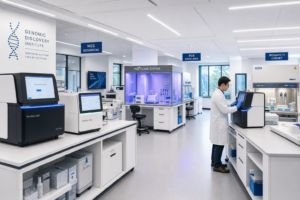
Effective battery research lab design starts with a facility layout that separates incompatible processes while maintaining efficient workflow connections. The goal is to minimize cross-contamination risk, isolate high-hazard operations, and create logical flow paths for materials, researchers, and waste streams.
- Zoned layout approach: Divide the facility into distinct zones for cell fabrication (dry room), electrochemical testing, materials characterization, and chemical storage. Each zone should have independent ventilation and access controls.
- Dry room placement: Position the dry room at the center of the fabrication workflow. Lithium-ion electrode preparation and cell assembly require humidity levels below 1% RH, and the dry room must be easily accessible from both materials prep and testing areas.
- Testing bay isolation: Locate battery cycling and abuse testing bays in a separate wing or behind fire-rated barriers. These areas generate heat and carry fire risk during thermal runaway testing, nail penetration tests, and overcharge studies.
- Support space allocation: Dedicate at least 30% of total lab area to support functions including chemical storage, gas cylinder corrals, waste staging, gowning areas, and equipment maintenance rooms.
- Emergency egress: Design at least two exit paths from every occupied zone. Battery research areas require clear egress routes that do not pass through chemical storage or high-voltage testing zones.
Ventilation and Environmental Controls for Battery Testing Labs
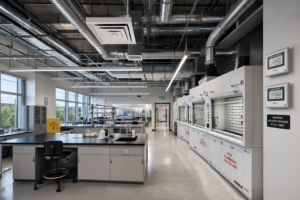
Ventilation design is arguably the most critical technical element in battery research lab design. Battery materials emit flammable vapors, toxic gases during thermal events, and fine particulates during electrode processing. Your ventilation system must handle all of these challenges while maintaining the precise environmental conditions that sensitive research demands.
General lab ventilation should provide a minimum of 8 to 12 air changes per hour (ACH) in standard work areas. Battery testing bays and abuse testing chambers require higher ventilation rates, typically 15 to 20 ACH, with dedicated exhaust systems that activate automatically when gas sensors detect elevated concentrations of hydrogen fluoride, carbon monoxide, or volatile organic compounds.
For strategies on reducing energy costs while maintaining safe ventilation rates, see Energy Efficient Laboratory Design. Smart ventilation controls that adjust airflow based on occupancy and sensor readings can cut HVAC energy consumption by 30 to 50 percent compared to constant-volume systems.
- Install point-of-use exhaust at battery cycling stations to capture off-gases before they enter the general lab environment.
- Use non-sparking, explosion-proof exhaust fans in areas where flammable electrolyte vapors may be present.
- Maintain dry room HVAC systems on dedicated, redundant circuits. Humidity excursions above target levels can ruin weeks of electrode preparation work.
- Monitor differential pressure between lab zones continuously. Battery fabrication areas should maintain positive pressure relative to corridors to prevent particulate infiltration.
Safety Infrastructure for Battery Research Lab Design
Safety infrastructure in a battery research facility goes far beyond standard lab provisions. The combination of high-energy electrical systems, flammable solvents, reactive metals, and thermal hazards demands a layered safety approach that addresses fire, chemical exposure, electrical shock, and environmental contamination.
Fire suppression systems in battery testing areas require special consideration. Standard water-based sprinkler systems are insufficient and potentially dangerous for lithium battery fires. Facilities should install Class D fire extinguishing agents or specialized lithium battery fire suppression systems in testing bays and storage areas.
- Install continuous gas monitoring for hydrogen fluoride, carbon monoxide, and lower explosive limit (LEL) sensors in all areas where batteries are cycled, charged, or subjected to abuse testing.
- Provide spill containment and neutralization kits rated for electrolyte solvents (ethylene carbonate, dimethyl carbonate, and similar organic compounds) at every workstation.
- Equip testing bays with blast-resistant enclosures or barricades for abuse testing procedures including nail penetration, crush, and thermal runaway propagation studies.
- Install emergency power disconnect switches (e-stops) at every battery testing station and at all room exits. These must disconnect all power to test equipment within seconds.
- Maintain a dedicated chemical shower and eyewash station within 10 seconds of travel from any workstation handling liquid electrolytes.
Workstation and Furniture Requirements for Energy Research Facilities
The workstations and furniture in a battery research lab must withstand the specific chemical, thermal, and mechanical demands of clean energy research. Standard lab benches designed for general chemistry or biology work often lack the durability and chemical resistance that battery research requires.
Bench surfaces in electrolyte handling areas must resist attack from organic solvents, concentrated acids used in electrode preparation, and alkaline solutions. Epoxy resin and phenolic resin countertops provide excellent broad-spectrum chemical resistance for most battery research applications. For detailed guidance on selecting chemically resistant surfaces, see Chemical Resistant Lab Workstations for Heavy Industrial Environments.
Testing stations require heavy-duty benches rated for the weight of battery cycling equipment, environmental chambers, and high-current power supplies. Static load ratings of 500 pounds or more per linear foot are common requirements in battery testing bays.
- Use ESD-safe (electrostatic discharge) work surfaces and grounding straps at all cell assembly and handling stations.
- Install vibration-isolation tables for precision analytical equipment such as impedance spectroscopy systems and scanning electron microscopes.
- Select modular bench systems that can be reconfigured as testing programs evolve and new equipment is acquired.
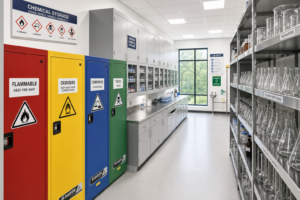
- Provide dedicated, ventilated storage cabinets for electrolyte chemicals that meet NFPA 30 requirements for flammable liquid storage.
Future-Proofing Your Battery Research Lab Design
The clean energy field evolves rapidly. Solid-state batteries, sodium-ion systems, lithium-sulfur chemistries, and next-generation fuel cells are all competing for research attention and commercial viability. Your battery research lab design must accommodate technologies and equipment that do not yet exist.
The most effective future-proofing strategy is to build flexibility into every system. Modular furniture, reconfigurable utility distribution, oversized electrical service capacity, and adaptable ventilation controls all contribute to a facility that can pivot without major renovation. For more on designing labs that adapt to emerging technologies, see Designing Lab Spaces for Future Technologies.
- Install electrical service capacity at 150% of current requirements. Battery testing equipment power demands are increasing with each generation of higher-energy-density cells.
- Use raised access flooring in testing areas to allow easy rerouting of power, data, and cooling lines as equipment layouts change.
- Design HVAC systems with capacity headroom and variable-speed drives that can serve additional fume hoods or exhaust points without replacing air handling units.
- Plan for glovebox expansion. As solid-state battery research grows, demand for inert-atmosphere work areas is increasing across the industry.
- Select furniture systems with standardized mounting points and accessories so that new instrument supports, shelving, and utility connections can be added without replacing existing benches.
Partnering for Successful Clean Energy Lab Planning
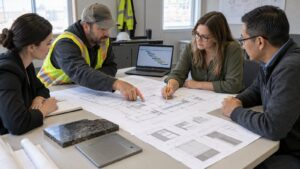
Designing a high-performance battery research facility is a multidisciplinary effort that requires close coordination between researchers, facilities engineers, safety officers, and lab furniture specialists. No single team has all the expertise needed to address the ventilation, safety, electrical, structural, and workflow challenges that battery research presents.
Start the planning process early. Engage your lab furniture and equipment partners during the conceptual design phase, not after architectural drawings are finalized. Early involvement allows furniture specialists to identify utility requirements, clearance constraints, and workflow optimizations that are difficult and expensive to incorporate later.
Genie Scientific partners with clean energy research organizations to design, furnish, and equip battery research laboratories that meet the demanding requirements of this fast-moving field. From initial space planning through installation and ongoing support, working with an experienced lab furniture partner ensures your facility is built to perform from day one and adapt as your research program grows.