
Laboratories are among the most energy-intensive spaces in any facility, driven largely by continuous ventilation demands, safety requirements, and specialized equipment. As energy costs continue to rise, lab managers, facility planners, and design teams are under increasing pressure to reduce operating expenses—without compromising safety, compliance, or performance.
This is where energy efficient laboratory design becomes a critical strategic advantage. Rather than relying on isolated equipment upgrades or short-term fixes, a well-planned laboratory integrates ventilation systems and equipment layout from the outset to minimize energy waste while maintaining strict environmental control.
Smart airflow management, properly selected ventilation systems, and intentional equipment placement can dramatically reduce HVAC loads, which often account for the largest share of a lab’s energy consumption.
By focusing on intelligent ventilation strategies and thoughtful lab layout, modern laboratories can achieve measurable energy savings, improved functionality, and long-term operational resilience.
In this article, we explore how energy efficient laboratory design reduces lab energy costs through smarter ventilation choices and optimized equipment layout—helping laboratories operate more sustainably and cost-effectively without sacrificing safety.

Why Laboratories Consume So Much Energy
Laboratories consume significantly more energy than standard commercial or office spaces due to their unique operational and safety requirements. While offices are designed for intermittent occupancy and relatively stable environmental conditions, laboratories must maintain precise airflow, temperature, and pressure control around the clock.
One of the primary drivers of high energy use is ventilation. Laboratories require high air change rates (ACH) to dilute and remove hazardous fumes, vapors, and particulates. Unlike typical buildings that recirculate air, labs rely heavily on 100% outside air, which must be continuously conditioned, heated, or cooled—placing a substantial load on HVAC systems.
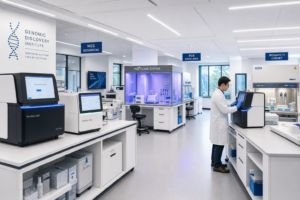
Energy demand is further amplified by specialized laboratory equipment. Fume hoods, biosafety cabinets, ultra-low temperature freezers, incubators, and analytical instruments operate continuously and often generate significant heat. This excess heat increases cooling demands, forcing ventilation and HVAC systems to work even harder to maintain stable conditions.
Poor equipment layout can also contribute to unnecessary energy consumption. When heat-generating equipment is scattered throughout the lab or placed near air supply diffusers and fume hoods, it disrupts airflow patterns and increases ventilation requirements. Inefficient layouts may also lead to higher air change rates than necessary, simply to compensate for uneven temperature distribution or airflow turbulence.
Without a holistic approach, these factors compound one another—resulting in inflated energy costs and reduced system efficiency. This is why energy efficient laboratory design focuses on addressing ventilation demands, equipment selection, and layout planning together, rather than treating them as separate challenges.

Smart Ventilation: The Cornerstone of Energy Efficient Laboratory Design
Ventilation is the single largest energy driver in most laboratories, often accounting for more than half of total energy consumption. For this reason, smart ventilation strategies sit at the heart of energy efficient laboratory design, balancing stringent safety requirements with the need to control long-term operating costs.
At its core, laboratory ventilation must protect occupants by safely removing hazardous contaminants while maintaining proper temperature, humidity, and pressurization. However, traditional approaches often rely on conservative, one-size-fits-all air change rates that exceed what many lab spaces actually require. Modern lab design replaces this mindset with right-sized ventilation strategies tailored to the specific function, risk level, and occupancy of each space.
One of the most effective approaches is demand-controlled ventilation (DCV). By using sensors to monitor occupancy, sash position, or air quality, DCV systems automatically adjust airflow in real time. This allows labs to reduce air changes during low-use periods without compromising safety, significantly lowering energy use associated with heating, cooling, and moving large volumes of air.
System selection also plays a critical role. Variable air volume (VAV) systems adjust airflow based on real-time demand, making them far more energy-efficient than constant air volume (CAV) systems that operate at fixed rates regardless of lab activity. When paired with high-performance controls, VAV systems offer flexibility for changing research needs while supporting long-term energy efficient laboratory design goals.
Equally important is the integration of ventilation planning early in the lab design process. Supply and exhaust locations, diffuser selection, and airflow patterns must align with equipment placement and user workflows. Poor coordination can lead to turbulence, short-circuiting of air, or over-ventilation—each of which drives up energy consumption and reduces system effectiveness.
Genie Scientific approaches ventilation design with a safety-first, efficiency-driven mindset. By coordinating ventilation systems with fume hoods, lab furniture, and equipment layouts, Genie helps laboratories achieve compliant, high-performing spaces that use only the energy they truly need—no more, no less.

Fume Hood Selection and Placement for Energy Savings
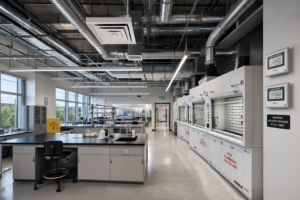
Fume hoods are essential to laboratory safety, but they are also one of the most energy-intensive components in any lab environment. A single conventional fume hood can exhaust thousands of cubic feet of conditioned air every minute, placing a continuous and significant load on HVAC systems. For this reason, thoughtful fume hood selection and placement are critical elements of energy efficient laboratory design.
Modern high-performance fume hoods are engineered to provide superior containment at much lower airflow rates than traditional models. Low-flow and high-efficiency fume hoods reduce the volume of air required to maintain safe face velocities, directly lowering the energy needed to heat, cool, and move air. When specified correctly, these hoods deliver both safety and substantial operational cost savings over the life of the laboratory.
User behavior also plays a meaningful role in fume hood energy consumption. Open sashes dramatically increase exhaust airflow, even when the hood is not actively in use. Incorporating automatic sash closers, sash sensors, and visual airflow indicators encourages proper use and supports ventilation systems in operating at their most efficient levels. These features are especially effective when integrated into a demand-controlled ventilation strategy.
Equally important is where fume hoods are placed within the laboratory. Poor placement—such as positioning hoods near doors, high-traffic areas, or air supply diffusers—can disrupt airflow patterns and compromise containment. This often leads to higher exhaust rates to compensate for turbulence, increasing energy use unnecessarily. Strategic hood placement minimizes cross-drafts, improves containment stability, and allows ventilation systems to operate at lower, more efficient setpoints.
Genie Scientific specializes in specifying and integrating high-performance fume hood systems that align with broader energy efficient laboratory design goals. By combining advanced hood technologies with intelligent layout planning and coordinated ventilation design, Genie helps laboratories reduce energy costs while maintaining the highest standards of safety and compliance.

Equipment Layout: Designing Labs That Work Smarter, Not Harder
Equipment layout plays a far greater role in laboratory energy consumption than many facilities realize. Even the most advanced ventilation systems can be undermined by poor spatial planning, while a well-considered layout can significantly enhance the effectiveness of energy efficient laboratory design.
One of the key principles of energy-conscious lab layout is zoning. Grouping equipment with similar ventilation and thermal requirements allows HVAC systems to operate more efficiently. High-energy and heat-generating equipment—such as freezers, centrifuges, and analytical instruments—should be clustered where exhaust and cooling can be managed effectively, rather than dispersed throughout the lab. This reduces localized heat buildup and minimizes the need for higher air change rates across the entire space.
Separating heat-producing equipment from sensitive work areas is equally important. When warm equipment is placed near fume hoods, supply diffusers, or temperature-sensitive processes, it disrupts airflow patterns and forces ventilation systems to work harder to maintain stable conditions. Thoughtful placement supports consistent airflow, improves comfort, and reduces unnecessary energy demand.
Traffic flow also affects energy performance. Excessive foot traffic near fume hoods or critical airflow zones can cause turbulence and compromise containment, prompting systems to compensate with increased exhaust rates. Designing clear circulation paths away from ventilation-sensitive areas helps maintain containment integrity while supporting lower, more efficient airflow setpoints.
Layout decisions should also account for future flexibility. Modular casework, adaptable benching, and thoughtfully positioned services allow labs to evolve without requiring costly—and energy-intensive—ventilation system modifications. This forward-looking approach is a hallmark of effective energy efficient laboratory design, ensuring long-term performance as research needs change.
By aligning equipment placement with ventilation strategy and workflow requirements, laboratories can reduce energy waste while improving safety, productivity, and usability. When layout is treated as a strategic design element rather than an afterthought, labs truly begin to work smarter—not harder.
Additional reading: Energy-Efficient Fume Hoods: VAV, Low-Flow & Sash Management

Integrating Ventilation and Layout for Maximum Efficiency
True energy efficient laboratory design is achieved when ventilation systems and equipment layout are planned as a single, integrated strategy rather than as independent components. When these elements are coordinated from the earliest design stages, laboratories can operate safely and efficiently while avoiding the energy penalties that come from mismatched systems and space planning.
Ventilation performance is directly influenced by what occupies the lab and where it is placed. Fume hoods, heat-generating equipment, and high-use work zones all affect airflow patterns, pressure relationships, and HVAC demand. By aligning equipment layout with ventilation zoning, designers can tailor air change rates to actual risk and usage levels instead of over-ventilating entire spaces as a precaution.
Integrated planning also supports more stable airflow and improved containment. Supply diffusers, exhaust grilles, and fume hoods can be positioned to work together, minimizing turbulence, short-circuiting, and cross-drafts. This energy efficient laboratory design allows ventilation systems to operate at lower, more consistent airflow rates—reducing energy consumption while maintaining safety and regulatory compliance.
Flexibility is another major advantage of an integrated approach. Laboratories are dynamic environments, and changes to equipment or workflows can quickly undermine efficiency if ventilation and layout were not designed with adaptability in mind. Coordinated systems make it easier to reconfigure spaces, add equipment, or expand research capacity without triggering costly ventilation upgrades or increased energy use.
Genie Scientific brings this integrated philosophy to every project, coordinating lab furniture, fume hoods, and ventilation systems to function as a cohesive whole. This holistic approach not only improves performance on day one but also protects long-term operational efficiency—ensuring that energy efficient laboratory design continues to deliver value as laboratory needs evolve.

The Role of Professional Lab Planning and Engineering
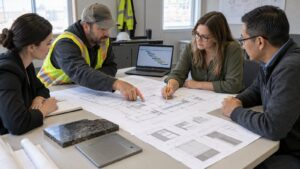
Achieving meaningful energy savings in a laboratory is rarely the result of isolated upgrades or off-the-shelf solutions. Without a coordinated plan, even high-efficiency equipment can fall short of its potential. This is why professional lab planning and engineering play a pivotal role in successful energy efficient laboratory design.
One of the biggest risks labs face is piecemeal decision-making—upgrading ventilation systems without considering layout, adding new equipment without assessing airflow impact, or selecting fume hoods without integrating them into the broader HVAC strategy. These fragmented approaches often lead to over-ventilation, inefficient airflow patterns, and escalating energy costs despite good intentions.
A professional lab planning partner takes a holistic view of the laboratory environment and energy efficient laboratory design. This includes evaluating space usage, safety requirements, equipment loads, ventilation demands, and future growth. By coordinating these factors from the outset, planners can right-size systems, eliminate redundancies, and design labs that operate efficiently under real-world conditions—not just on paper.
Genie Scientific’s single-source approach is especially valuable in this context. By bringing together expertise in fume hoods, lab furniture, ventilation coordination, and equipment layout, Genie ensures that all components work together seamlessly. This integrated process reduces design conflicts, shortens project timelines, and supports long-term energy efficient laboratory design goals.
Beyond initial design, professional planning also helps laboratories remain adaptable. As research needs evolve, a well-engineered lab can accommodate changes without major system overhauls or increased energy consumption. This foresight protects both operational budgets and sustainability objectives, delivering lasting value well beyond the commissioning phase.

Conclusion: Lower Energy Costs Without Compromising Safety
Reducing laboratory energy costs does not require sacrificing safety, performance, or flexibility. As this article has shown, the most effective savings come from intentional, integrated decisions—particularly around ventilation strategy and equipment layout. When these elements are planned together, laboratories can dramatically reduce HVAC demand, improve airflow stability, and support safer, more productive work environments.
From smart ventilation systems and high-performance fume hoods to thoughtful equipment zoning and professional lab planning, energy efficient laboratory design is about working smarter at every level of the lab. Rather than relying on over-ventilation as a safety buffer, modern labs use precision design to deliver protection only where and when it is needed.
Genie Scientific’s expertise lies in bringing these strategies together seamlessly. By coordinating fume hoods, lab furniture, ventilation requirements, and equipment layout through a single-source approach, Genie helps laboratories achieve lasting energy savings while meeting strict regulatory and safety standards. The result is a lab that performs efficiently today and remains adaptable for the demands of tomorrow.
If you’re planning a new laboratory or looking to reduce energy costs in an existing facility, consult Genie Scientific to explore tailored solutions built around energy efficient laboratory design. Their integrated planning approach ensures your lab is safer, smarter, and more cost-effective—now and well into the future.