
The deadline is tight. The client is demanding. The scope is technical. And everyone on the job knows that one weak link in the laboratory package can put the entire project at risk.
For construction leaders managing complex laboratory construction, the challenge is not simply finding someone who can supply fume hoods, casework, countertops, and lab furniture. The real challenge is finding a partner who can help protect the schedule, clarify the scope, coordinate the details, and deliver when the stakes are uncomfortably high.
Lab construction has a way of exposing every gap in a project:
- A missed dimension becomes a field conflict.
- A vague proposal becomes a change-order dispute.
- A delayed submittal ripples through procurement, fabrication, installation, commissioning, and occupancy.
- A poorly coordinated fume hood package creates safety, performance, and ventilation concerns nobody wants to discover late in the job.
That is why experienced project leaders do not treat laboratory infrastructure as “just another product package.” It is a coordination-heavy, safety-sensitive, schedule-critical portion of the project. And when a complicated client needs a complicated lab delivered fast, the decision becomes bigger than price.
It becomes a question of certainty.
The Real Pressure Behind a Complicated Laboratory Construction Project
On paper, a laboratory package looks like a list of products: fume hoods, steel casework, workbenches and tables, shelving, epoxy or phenolic resin countertops, cabinets, fixtures, and accessories.
In the field, that list turns into dozens of high-consequence questions:
- Are the dimensions coordinated with actual room conditions, not just the drawings?
- Are the fume hoods aligned with the mechanical design and airflow requirements?
- Are the materials appropriate for the lab’s chemical exposure and use case?
- Are the submittals complete enough to keep approvals moving?
- Is the installation plan realistic for the project schedule?
- Who is responsible when product, field conditions, sequencing, and client expectations collide?
These questions create pressure for project executives, general contractors, facility teams, architects, lab planners, and owners alike. Nobody wants to explain why a lab opening slipped because the scope was vague, the vendor was reactive, or the installation details were never fully owned.
The pressure is also built into how labs are specified. Industry bodies like the Scientific Equipment and Furniture Association publish separate SEFA standards for fume hoods, installation, work surfaces, casework materials, and even scope of work — a signal of how many distinct responsibilities sit inside one lab furniture package.
In a high-risk project environment, the safest choice is rarely the vendor who only says, “We can provide the product.” The safer choice is the partner who says, “We understand the full project reality, and we have a process to help manage it.”
Why Product-Only Thinking Creates Project Risk
Product quality matters. Specifications, certifications, durability, finishes, airflow performance, chemical resistance, and testing all matter.
But product quality alone does not save a poorly coordinated project.
Consider fume hoods. Performance is not just a property of the box that ships from the factory. ANSI/ASHRAE Standard 110 evaluates containment through flow visualization, face velocity measurement, and tracer gas testing, and many owners and agencies require installed hoods to be field-tested. The U.S. Department of Veterans Affairs fume hood specification, for example, calls for field testing installed hoods to ASHRAE 110 and correcting or replacing units that fail. That means hood placement, room conditions, and exhaust coordination all influence whether the package performs as intended.
Casework and countertops carry the same kind of hidden dependency. University lab design guides, such as the University of Michigan casework standard, direct designers to review countertop and casework material compatibility with planned chemical use and anticipated load requirements. A product that is excellent in one lab can be the wrong choice in another. (For a deeper comparison, see Genie’s guide to choosing lab countertop materials.)
A laboratory buildout requires alignment across design, engineering, estimating, fabrication, sourcing, project management, delivery, installation, and quality control. When those functions are fragmented across disconnected vendors, the burden shifts back onto the construction team. Suddenly the project team is:
- Chasing answers across multiple suppliers.
- Closing scope gaps nobody priced.
- Reconciling drawings that do not match each other.
- Managing conflicts between trades.
- Trying to keep the schedule from slipping.
That is exactly the burden busy project leaders are trying to avoid. For complicated laboratory projects, the right partner should reduce management load, not increase it — especially when liquidated damages, client escalation, delayed revenue, or reputational consequences are on the line.
What Project Certainty Looks Like in Laboratory Infrastructure
Project certainty does not mean every challenge disappears. Complex construction always has variables. It means the laboratory infrastructure scope is handled with enough control, communication, and experience that the team can move forward with confidence.
In practical terms, project certainty looks like this:
- A clearer proposal from the start. The team understands what is included, what is not, what needs coordination, and where risk may exist.
- Design and engineering support. The package is shaped around actual facility needs, technical requirements, layout, workflow, and budget.
- Custom fabrication capability. Nonstandard dimensions, finishes, materials, and configurations are addressed without forcing the project into a one-size-fits-all catalog.
- Integrated sourcing. Fume hoods, steel products, casework, counters, workbenches, shelving, and lab fixtures and accessories are coordinated as a package rather than as isolated purchases.
- Project management ownership. Someone watches the details from proposal through installation and does not disappear after the order is placed.
- Installation capability. The handoff from fabrication and delivery to field execution is managed with awareness of site conditions, sequencing, and schedule pressure.
- Quality control. The installed package reflects the expectations set early in the project.
That kind of certainty turns a risky laboratory package into a controlled project path.
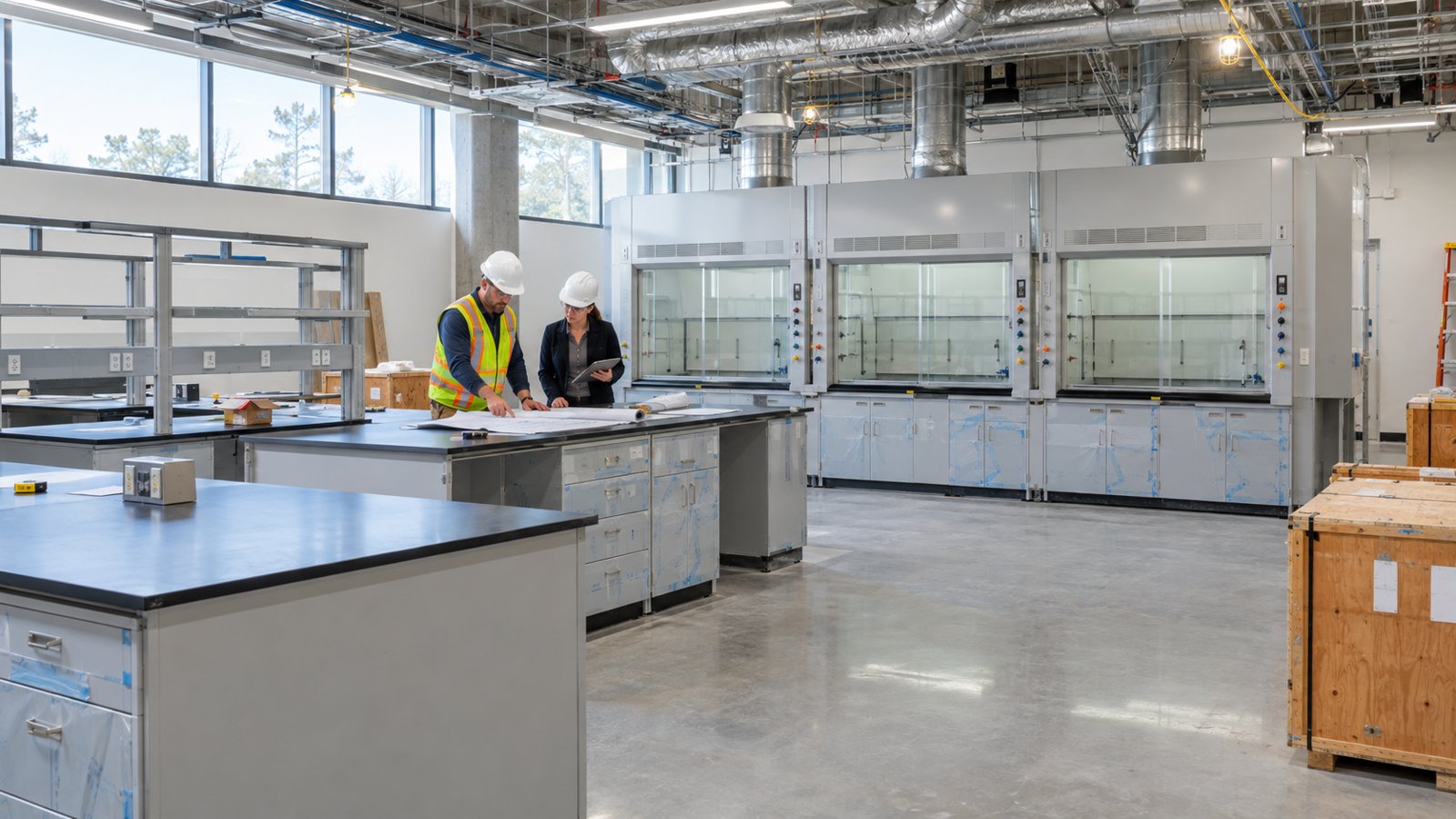
A lab project coordination meeting with an architect, superintendent, lab planner, and furniture project manager reviewing floor plans, casework shop drawings, and material samples
The Advantage of a Single-Source Laboratory Infrastructure Partner
For demanding lab construction projects, a single-source approach can make an enormous difference. Instead of managing multiple vendors who each own one slice of the solution, the project team works with a partner that understands how the pieces connect.
That is where Genie Scientific’s integrated model stands out.
Genie Scientific is a manufacturer, dealer, and installer of laboratory infrastructure based in Fountain Valley, California, and has been designing, manufacturing, and installing fume hoods and lab furniture since 1979. The company supports specialized laboratory environments across research, pharmaceutical, industrial, healthcare, education, government, and other technical sectors — you can see examples in the Genie project portfolio.
Rather than operating as a commodity lab furniture supplier, Genie brings the critical functions together under one roof. According to its company overview, in-house operations include estimating, design, engineering, project management, sheet-metal fabrication, powder coating, assembly, warehouse consolidation, and quality assurance and quality control.
Here is how that model maps to the project risks above:
| Project risk | How an integrated model helps |
| Vague scope and pricing | In-house estimating and design shape the proposal around the actual layout |
| Nonstandard dimensions or finishes | Fume hoods and steel products are fabricated in Genie’s own Fountain Valley factory, including custom fume hoods |
| Multi-vendor sourcing gaps | Complementary equipment is sourced through a nationwide OEM supplier network and consolidated as one package |
| Coordination breakdowns | Each job has a dedicated project manager who coordinates with the client, general contractor, and other trades |
| Field execution | A foreman-led installation crew that is licensed, insured, and bonded, with union, non-union, and prevailing-wage capability |
For construction teams, that matters because control creates confidence. When a laboratory project is complex, custom, or schedule-sensitive, having more of the process connected under one delivery model helps reduce ambiguity. The team can ask better questions earlier, identify coordination issues sooner, and move toward installation with fewer surprises.
Five Ways to Reduce Risk Before the Project Gets Away From You
If the laboratory buildout already feels complicated, fast-moving, or politically sensitive, waiting for problems to surface is not a strategy. The smartest project teams reduce risk before it becomes visible to the client.
1. Demand proposal clarity, not just pricing
A low number with vague scope can become expensive later. Make sure the laboratory package clearly defines:
- Major products and quantities
- Custom requirements
- Exclusions and assumptions
- Schedule considerations
- Installation responsibilities
SEFA even maintains a dedicated scope of work standard to help divide responsibility between trades — a useful reference point when comparing proposals.
2. Pressure-test the partner’s project process
Ask how the vendor manages submittals, fabrication, sourcing, change coordination, site readiness, installation, and quality control. Strong partners are not offended by these questions. They welcome them because they know process is part of the value.
3. Confirm fit for custom and nonstandard requirements
Many laboratory projects do not fit neatly into a catalog. If the project includes unusual dimensions, specialized surfaces, workflow constraints, ventilation requirements, or client-specific preferences, choose a partner with custom fabrication and engineering capability. Genie’s guide to custom lab casework shows how tailored storage supports specific applications.
4. Connect product decisions to field realities
Fume hoods, casework, countertops, and workbenches do not exist in isolation. They interact with plumbing, electrical, mechanical systems, room balance, user workflow, safety expectations, and installation sequencing. The earlier those realities are coordinated, the safer the project becomes. Genie’s laboratory ventilation guide and fume hood installation checklist and timeline are good starting points for those conversations.
5. Choose accountability over convenience
The easiest vendor to quote is not always the safest vendor to hire. For high-stakes laboratory work, prioritize the partner who can own details, communicate clearly, and stay engaged through the full project lifecycle.
A note on technical requirements: This article offers general planning guidance. Fume hood face velocity, exhaust design, containment testing criteria, and chemical-compatibility decisions should be set by the project’s mechanical engineer, the owner’s environmental health and safety team, and the governing specifications. Owners typically base hood certification programs on the OSHA Laboratory Standard and ANSI/ASSP Z9.5, according to ASHRAE’s technical guidance. Federally funded biomedical facilities may also need to meet the NIH Design Requirements Manual.
Questions to Ask Before You Award the Laboratory Package
Before you sign, use this short checklist with every bidder. The answers reveal quickly who is selling product and who is prepared to own outcomes.
- Scope: What exactly is included and excluded, and where are the coordination points with other trades?
- Submittals: What does your submittal package include, and what is your typical turnaround?
- Manufacturing: Which items do you fabricate yourself, and which do you source? Who manages lead times for each?
- Customization: How do you handle nonstandard dimensions, finishes, or field changes after approval?
- Field verification: Who verifies room dimensions and site readiness before fabrication and delivery?
- Installation: Do you self-perform installation? Who leads the crew on site?
- Quality control: How do you confirm the installed package matches the approved submittals?
- Closeout: What support do you provide after installation and through the owner’s acceptance testing?
If the project is a renovation inside an occupied building, add phasing and disruption questions as well. Genie’s guide to laboratory renovation planning without disrupting ongoing research covers what to plan for.
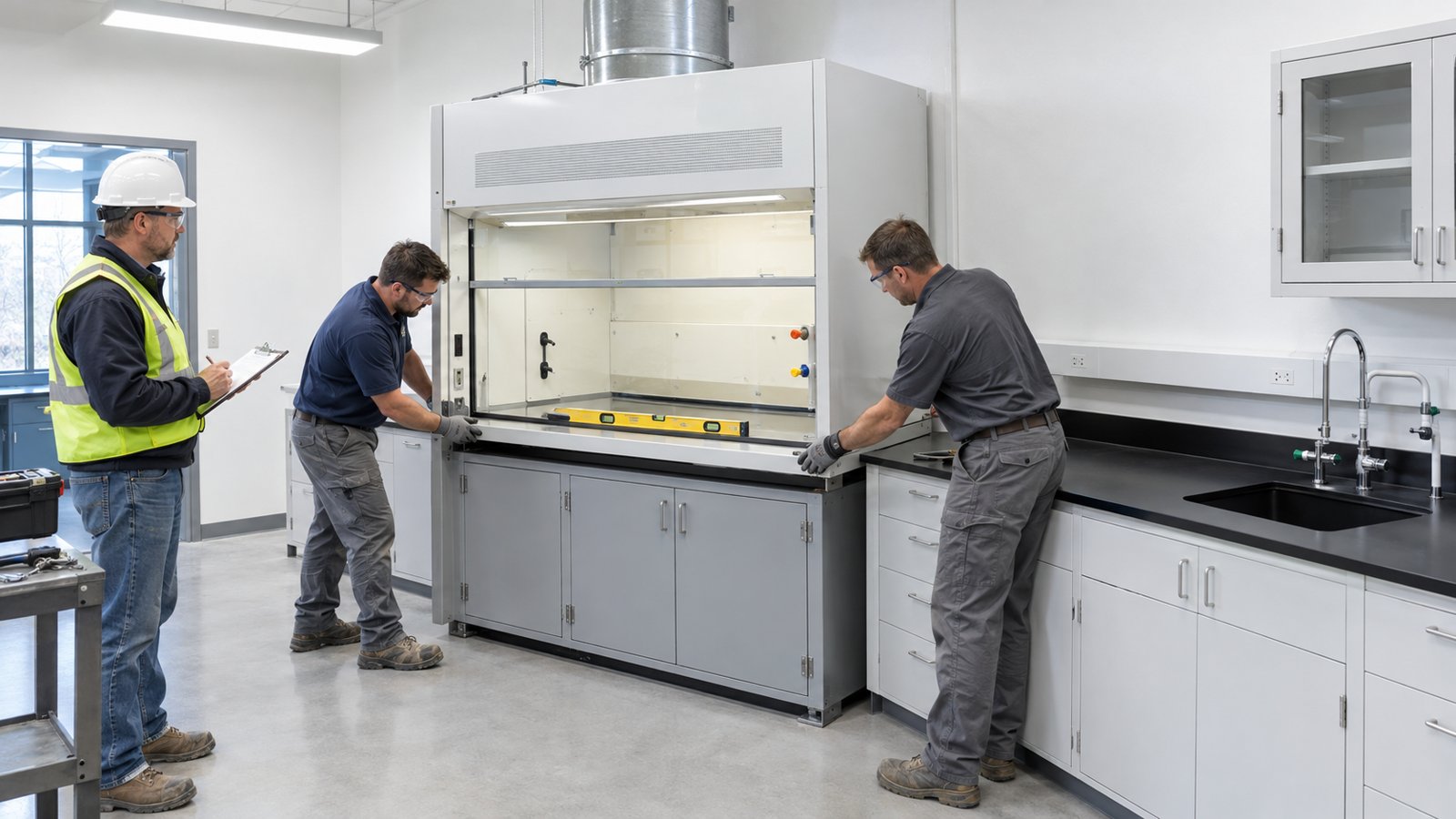
Installers leveling a new floor-standing fume hood on a steel base cabinet while a foreman checks alignment beside finished casework and an epoxy countertop sink
What Success Looks Like on a High-Stakes Lab Buildout
Success is not just a completed lab.
Success is walking into the next owner meeting with confidence because the laboratory package is scoped, documented, coordinated, and moving. It is knowing the fume hood and casework details are not being left to chance. It is watching the client’s trust grow because the project team has a real plan. And it is fewer escalations, fewer avoidable surprises, and no late-stage panic turning a promising project into a stressful one.
For project leaders, the win is bigger than furniture, hoods, and countertops. The win is protection:
- Protection of the schedule
- Protection of the client relationship
- Protection of project margin
- Protection of the professional reputation that took years to build
Ready to bring control to a complicated laboratory buildout? If your team is staring down a fast-moving, high-risk lab project, do not settle for a product-only vendor who leaves you managing the gaps. Explore how Genie Scientific’s integrated laboratory infrastructure model supports projects from planning and proposal through fabrication, sourcing, installation, and quality control.
Connect with Genie Scientific to discuss your laboratory buildout and get the clarity, coordination, and confidence your project deserves