
From Smart Labs to Fully Automated Lab Design
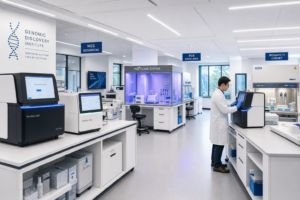
Laboratories are no longer designed solely around benches, equipment, and square footage. As scientific research becomes more data-driven, time-sensitive, and complex, the physical lab environment must evolve alongside the technologies it supports. This shift has given rise to automated lab design—a holistic approach that integrates artificial intelligence, automation, and intelligent infrastructure directly into the workspace itself.
While previous advancements focused on introducing AI-enabled instruments or robotic systems into existing layouts, automated lab design represents a more fundamental transformation. It considers how workflows, equipment, furniture, and digital systems interact as a unified ecosystem. The result is a lab that not only supports advanced technology but actively enhances efficiency, accuracy, safety, and adaptability.
By embedding automation and AI into the core design of laboratory spaces, organizations can create environments that respond to changing research demands, optimize daily operations, and remain future-ready. As laboratories move toward greater autonomy and smarter decision-making, automated lab design is becoming a critical foundation for the next generation of scientific workspaces.
What Is Automated Lab Design?
Automated lab design is the intentional integration of artificial intelligence, automation technologies, and physical lab infrastructure into a single, coordinated workspace. Rather than adding automated systems after a lab is built, this approach embeds intelligence directly into the layout, workflows, and supporting systems from the earliest design stages.
At its core, automated lab design focuses on how people, equipment, data, and space interact. AI-driven planning tools help optimize layouts for efficiency and safety, while automation enables consistent, repeatable processes across daily operations. Sensors, smart systems, and connected devices continuously collect data, allowing the lab environment to adapt in real time to changing workloads and operational demands.
This approach differs significantly from traditional lab design, where spaces are often static and automation is treated as a standalone upgrade. In automated labs, workflows are mapped holistically—considering sample movement, equipment placement, data flow, and human interaction as part of an interconnected system. The result is a lab that is not only more efficient, but also more flexible and future-ready.
Automated lab design also shifts the role of the laboratory from a passive workspace to an active contributor to research outcomes. By supporting predictive maintenance, optimized resource use, and intelligent decision-making, these environments help reduce errors, improve turnaround times, and support higher-quality results.
For modern laboratories facing increasing pressure to do more with less, automated lab design provides a scalable foundation for long-term performance and innovation.

The Core Technologies Powering Automated Lab Design
Automated lab design is driven by a combination of digital intelligence and physical automation working together across the entire workspace. Rather than relying on a single technology, these labs integrate multiple systems that continuously inform, adapt, and optimize how the environment functions.
AI-Driven Planning and Space Optimization
Artificial intelligence plays a critical role in the early stages of automated lab design. AI-powered planning tools analyze workflow patterns, equipment requirements, safety clearances, and personnel movement to create layouts that maximize efficiency and reduce bottlenecks.
These insights allow designers to anticipate operational challenges before construction begins, resulting in spaces that support smoother daily workflows and long-term adaptability.
Automation and Robotics at the Workspace Level
Automation extends beyond individual instruments to influence how the entire lab operates. Robotic systems can support repetitive or high-precision tasks, while automated material handling and sample movement reduce manual intervention.
In automated lab design, these systems are incorporated into the layout itself, ensuring proper clearances, power access, and workflow alignment rather than forcing retrofits later.
Smart Systems, Sensors, and Connected Infrastructure
Sensors and connected systems form the nervous system of an automated lab. Environmental monitoring, equipment status tracking, and occupancy sensing provide real-time data that supports safer and more efficient operations.
This continuous feedback allows lab environments to adjust lighting, ventilation, and equipment usage dynamically, contributing to improved performance and resource efficiency.
Digital Twins and Predictive Modeling
Digital twin technology enables laboratories to simulate real-world conditions before and after a space is built. By creating virtual models of lab environments, designers can test workflows, assess equipment placement, and predict future performance.
Within automated lab design, digital twins support better decision-making, reduced downtime, and ongoing optimization as lab needs evolve.
How Automated Lab Design Transforms Daily Lab Operations
Automated lab design doesn’t just introduce advanced technology—it reshapes how laboratories function on a day-to-day basis. By aligning physical layouts, intelligent systems, and automation from the outset, these environments support smoother operations and more consistent outcomes.

Streamlined Workflows and Increased Efficiency
In an automated lab, workflows are carefully mapped to minimize unnecessary movement and manual handling. Samples, data, and materials move through clearly defined paths, reducing delays and congestion.
AI-informed layouts help ensure that frequently used equipment is positioned for easy access, allowing researchers and technicians to spend less time navigating the space and more time focused on their work.
Improved Accuracy and Reduced Human Error
Repetitive and precision-based tasks are particularly well suited to automation. By embedding automated processes into the lab’s design, organizations can reduce variability caused by manual handling.
This leads to more consistent results, fewer errors, and improved data integrity—especially in high-throughput or time-sensitive environments.
Faster Turnaround Times
Automation enables labs to operate more efficiently without increasing staff workload. Integrated systems support continuous processing, real-time monitoring, and faster handoffs between steps.
As a result, automated lab design helps laboratories meet demanding timelines while maintaining quality and compliance.
Enhanced Collaboration Between People and Technology
Rather than replacing human expertise, automated lab design creates environments where people and technology work together more effectively. Intelligent systems handle routine tasks and data collection, allowing staff to focus on analysis, problem-solving, and decision-making.
Clear sightlines, ergonomic layouts, and thoughtfully integrated technology support safer and more productive collaboration.
Designing for Flexibility—Modular and Scalable Automated Labs
As laboratories adopt more advanced automation, flexibility becomes just as important as performance. Automated lab design must anticipate change, allowing spaces to evolve alongside new technologies, shifting research priorities, and growing operational demands.
Modular Layouts That Adapt Over Time
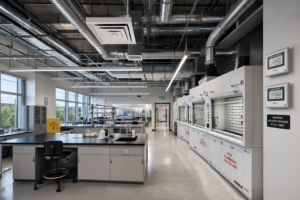
Modularity is a cornerstone of automation-ready labs. Reconfigurable layouts make it easier to introduce new equipment, adjust workflows, or expand capacity without major disruption. By designing with standardized dimensions, movable casework, and adaptable infrastructure, automated labs can be modified efficiently as needs change.
Scalable Infrastructure for Future Automation
Automation often increases over time rather than arriving all at once. Automated lab design accounts for this by incorporating scalable power, data, ventilation, and utility systems from the beginning. This forward-thinking approach reduces the need for costly retrofits and ensures that future automation upgrades can be integrated smoothly.
Supporting Technology Evolution Without Redesign
As AI tools and automation technologies continue to advance, labs must be able to accommodate new systems without starting from scratch. Flexible workstations, adjustable furniture, and open layouts allow automated labs to support evolving equipment footprints and operational requirements. This adaptability helps laboratories remain competitive and future-ready.
Long-Term Value Through Smart Design Decisions
Designing for flexibility extends the lifespan of a lab environment. Automated lab design that prioritizes modularity and scalability supports continuous improvement while protecting long-term investment. For organizations planning beyond immediate needs, this approach delivers both operational resilience and lasting value.

Safety, Compliance, and Human-Centered Automation
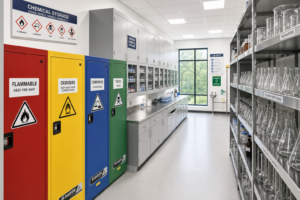
As laboratories become more automated, safety and compliance remain non-negotiable. Automated lab design enhances these priorities by embedding protective measures directly into the workspace, rather than relying solely on procedural controls or manual oversight.
Designing Automation Around People
Human-centered automation places researchers and technicians at the core of the lab environment. Automated lab design considers ergonomics, visibility, and intuitive workflows to ensure that technology supports—not complicates—daily tasks. Clear sightlines, accessible controls, and well-defined work zones help staff interact safely and confidently with automated systems.
Built-In Safety Through Intelligent Systems
Automation allows safety features to be proactive rather than reactive. Sensors and monitoring systems can detect environmental changes, equipment malfunctions, or unsafe conditions in real time. By integrating these technologies into the lab’s design, automated environments can respond quickly to potential risks, reducing exposure and supporting safer operations.
Supporting Regulatory Compliance
Compliance requirements continue to evolve across research, clinical, and industrial labs. Automated lab design helps organizations meet these demands by promoting consistency, traceability, and controlled workflows. Automated systems support accurate data capture and documentation, while well-planned layouts help maintain separation of processes and adherence to established protocols.
Reducing Risk While Enhancing Productivity
By automating repetitive or high-risk tasks, laboratories can minimize manual handling and reduce the potential for accidents. At the same time, human-centered design ensures that staff remain engaged in higher-value activities such as analysis and decision-making. This balance between automation and human expertise is essential for sustainable, compliant lab operations.

Real-World Applications—Where Automated Lab Design Is Making the Biggest Impact
Automated lab design is not limited to a single discipline or industry. Its principles are being applied across a wide range of laboratory environments, each with unique operational demands and performance goals. By integrating AI and automation at the workspace level, these labs are achieving greater efficiency, consistency, and scalability.
Research and Pharmaceutical Laboratories
In research-driven environments, automated lab design supports high-throughput workflows and data-intensive processes. Intelligent layouts streamline sample movement and equipment access, helping researchers manage complex experiments while maintaining accuracy and repeatability.
Automation also supports faster development cycles, a critical advantage in competitive research and pharmaceutical settings.
Biotechnology and Life Sciences Labs
Biotech and life sciences laboratories often require strict environmental control and precise workflows. Automated lab design enables consistent monitoring, optimized equipment placement, and improved coordination between processes.
These features support reproducibility and compliance while allowing labs to scale operations as research programs expand.

Clinical and Diagnostic Laboratories
Speed and reliability are essential in clinical and diagnostic settings. Automated lab design helps reduce manual handling, minimize errors, and improve turnaround times.
Integrated systems support standardized workflows and real-time tracking, contributing to more efficient operations and consistent results in high-volume environments.
Educational and Innovation Laboratories
Automation is increasingly shaping how future scientists are trained. Automated lab design in educational and innovation spaces supports flexible teaching environments, collaborative research, and exposure to advanced technologies.
These labs balance automation with accessibility, helping users understand and interact with intelligent systems in a safe, controlled setting.
The Future Outlook—What’s Next for Automated Lab Design
Automated lab design is still evolving, and its future will be shaped by advances in artificial intelligence, data integration, and intelligent infrastructure. As these technologies mature, laboratories will move beyond automation as a support tool and toward environments that actively optimize their own performance.

Smarter, More Autonomous Lab Environments
Future laboratories will increasingly rely on AI to analyze operational data and adjust workflows in real time. Automated lab design will enable self-optimizing spaces that can balance workloads, manage resources, and adapt to changing priorities with minimal manual intervention.
This shift will allow labs to operate more efficiently while maintaining high standards of safety and quality.
Deeper Integration Between Physical and Digital Systems
The line between digital systems and physical infrastructure will continue to blur. Automated lab design will increasingly connect equipment, furniture, building systems, and data platforms into unified ecosystems.
This integration will support more accurate forecasting, predictive maintenance, and long-term planning across laboratory operations.
Sustainability and Resource Optimization
Efficiency is not only about speed—it’s also about sustainability. Future automated labs will place greater emphasis on energy management, waste reduction, and responsible resource use.
Intelligent systems will help monitor consumption patterns and optimize environmental controls, supporting both operational efficiency and sustainability goals.

Designing Today for Tomorrow’s Innovation
Perhaps the most significant trend in automated lab design is the need for long-term foresight. Decisions made during the design phase will increasingly determine a lab’s ability to adopt new technologies and workflows years down the line.
By prioritizing flexibility, scalability, and intelligent infrastructure today, laboratories can position themselves to adapt confidently as automation continues to advance.
Why Automated Lab Design Requires an Integrated Design Partner
Automated lab design is complex, requiring more than individual technologies or standalone equipment. To achieve a truly efficient, flexible, and future-ready workspace, laboratories need an integrated approach from a trusted design partner.
Early-Stage Planning Is Critical
Automation and AI must be considered from the very beginning of the design process. Attempting to retrofit systems into existing labs often leads to inefficiencies, safety compromises, and higher costs.
An integrated partner ensures that layouts, workflows, and infrastructure are optimized for both current needs and future growth.
A Single-Source Solution for Technology, Furniture, and Workflow
Automated lab design requires coordination across multiple elements: furniture, cabinetry, workstations, utilities, and digital systems. A single-source partner like Genie Scientific provides seamless integration, ensuring that all components work together as a unified ecosystem.
This approach reduces risk, saves time, and supports smoother project delivery.

Expertise in Scalability and Flexibility
An integrated partner understands how to design labs that can evolve. From modular layouts to scalable infrastructure, their expertise ensures that the lab remains adaptable as new technologies emerge, workflows change, or research demands expand.
Supporting Long-Term Performance and Innovation
Automated lab design is a long-term investment. A knowledgeable partner not only delivers a functional workspace today but also builds in the flexibility, intelligence, and adaptability required for tomorrow’s challenges.
With the right partner, laboratories can confidently embrace automation, optimize operations, and stay ahead in an increasingly competitive landscape.
Additional Reading: How AI and Robotics Are Changing Lab Furniture
Conclusion: Designing Labs That Think, Adapt, and Evolve
The future of laboratory environments lies in automated lab design—spaces where AI, automation, and intelligent infrastructure work together seamlessly. From streamlining workflows and reducing errors to enhancing safety and sustainability, these labs are designed to be more than functional—they are adaptive, efficient, and future-ready.
By planning with automation in mind, incorporating modular layouts, and partnering with experienced designers, organizations can create laboratories that evolve alongside research needs, technological advancements, and operational demands. The result is a workspace that not only supports scientific discovery but actively accelerates it.
Take the next step: Explore how Genie Scientific can guide your lab from concept to completion, delivering fully integrated, automation-ready designs that position your organization at the forefront of innovation.