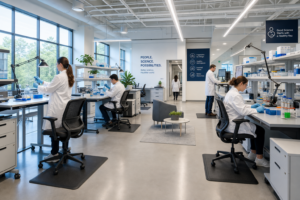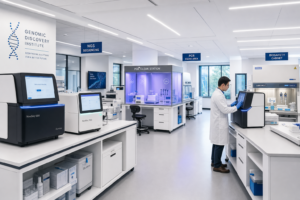

Once the exclusive domain of human researchers, today’s labs are rapidly evolving into hybrid environments where intelligent machines and people work side by side. From streamlining data analysis to automating repetitive tasks, AI and robotics are reshaping the way modern laboratories function.
As the pace of innovation accelerates, the need to adapt the physical workspace to meet these changes has become just as critical as adopting the technologies themselves.
In this new era of high-tech research, traditional lab setups are no longer enough. The rise of AI and robotics demands lab furniture that is smarter, more flexible, and designed for collaboration—not just among scientists, but also between humans and machines. From accommodating robotic arms to integrating sensor-driven systems, the very foundations of laboratory design are being reimagined.
In this article, we’ll look at how AI and robotics are transforming lab furniture needs, why adaptability is key, and how forward-thinking manufacturers like Genie Scientific are responding to this exciting shift.

The Rise of AI and Robotics in Modern Labs
The influence of AI and robotics is no longer limited to theoretical models or cutting-edge tech startups. These technologies have firmly established themselves in research institutions, pharmaceutical companies, academic labs, and even small-scale industrial facilities.
From machine learning algorithms that process vast datasets in seconds to robotic systems that handle delicate procedures with microscopic precision, the lab landscape is evolving at an unprecedented pace.
In biomedical research, AI and robotics are accelerating drug discovery by analyzing complex biological data and automating high-throughput screening. In diagnostics, robotic platforms paired with AI-driven image recognition are enhancing accuracy and reducing turnaround times. Materials science labs are also leveraging machine learning to predict chemical behaviors, enabling faster prototyping and innovation.
But this surge in technological capability comes with a logistical challenge: how to design workspaces that accommodate increasingly autonomous systems. Traditional labs were built around human-centered processes—fixed benches, static storage, and narrowly defined workflows. As machines take on more tasks, labs must become more dynamic, collaborative, and responsive to both human and robotic needs.
This shift isn’t a distant possibility—it’s already happening. And it’s setting the stage for a revolution in lab design, starting with one of its most overlooked elements: furniture.

How Traditional Lab Furniture Falls Short
While today’s labs are brimming with innovation, many are still outfitted with furniture designed for workflows of the past. Fixed-height benches, immovable casework, and static layouts may have once served the needs of human researchers—but they’re ill-equipped to support the fast-paced, adaptive nature of AI and robotics-driven operations.
For starters, robotic systems often require precise spatial alignment, unrestricted movement, and specific clearances that traditional furniture simply doesn’t provide. Fixed countertops and tightly packed work zones can obstruct robotic arms, limit mobility, and increase the risk of accidental collisions. What once offered structure now becomes a constraint in labs where flexibility is key.
Connectivity is another pain point. As AI and robotics increasingly rely on sensors, data streams, and real-time monitoring, labs need workstations that accommodate extensive wiring, power access, and data integration. Yet most legacy furniture lacks built-in channels or modular options to support this infrastructure, forcing labs to rely on makeshift solutions that hinder efficiency and safety.
There’s also the matter of human-robot interaction. In shared environments, safety and ergonomics are critical. Traditional lab setups—built around purely human use—don’t account for the dynamic movement or reach of robotic components. As a result, they may unintentionally create hazards or limit how seamlessly humans and machines can collaborate.
The result? A disconnect between cutting-edge capabilities and outdated physical design. And for labs embracing AI and robotics, that disconnect can stifle innovation.

New Demands on Lab Furniture: Flexibility, Mobility, and Integration
As laboratories embrace AI and robotics, the definition of “functional furniture” is being completely reimagined. No longer just a matter of surfaces and storage, lab furniture now plays a critical role in facilitating fluid, tech-driven workflows. Flexibility, mobility, and seamless integration have become the new gold standards.
Modularity is Key
With the pace of technological change, labs must be able to reconfigure layouts quickly and easily. Modular workbenches, mobile carts, and adjustable shelving allow researchers to create adaptive spaces that evolve alongside new equipment or processes. This kind of flexibility is essential when robotic systems are introduced—whether it’s a benchtop unit or a fully mobile robot navigating the lab floor.
Mobility Supports Collaboration
In AI-enhanced environments, data needs to move, and so do people and machines. Rolling workstations and lockable casters enable quick rearrangement for collaborative experiments, maintenance access, or changes in robotic pathing. Furniture that can adapt on the fly allows labs to remain agile without interrupting operations.
Integration is Non-Negotiable
As AI and robotics rely more heavily on sensors, software, and data flow, lab furniture must act as a silent partner in connectivity. Integrated power strips, USB ports, cable management systems, and even smart surfaces with embedded touch controls or monitoring features are becoming increasingly desirable.
These new demands are not just about convenience—they’re about creating an environment where technology can operate at full capacity. By aligning physical infrastructure with digital capability, labs can optimize both performance and safety.
Additional Reading: The Importance of Anti-Vibration Tables in Precision Lab Work

Designing for Human-Robot Interaction (HRI)
In a lab powered by AI and robotics, the design challenge isn’t just about fitting machines into the space—it’s about ensuring that humans and robots can work safely, efficiently, and intuitively side by side. This emerging field of Human-Robot Interaction (HRI) is influencing not only how we program machines, but how we configure the environment around them.
Safety is the Top Priority
Robotic systems often move with speed, precision, and limited peripheral awareness. To prevent collisions or accidents, lab furniture must allow for clearly defined robot pathways and human-safe zones. Rounded corners, recessed storage, and retractable work surfaces help minimize physical obstructions and create safer shared environments.
Ergonomics go Both Ways
While ergonomic design has long been focused on human comfort, it now extends to robotic functionality. For instance, robotic arms need stable, vibration-resistant surfaces for accurate operations, while researchers still require adjustable-height benches to reduce strain. Furniture that can serve both needs bridges this divide and supports seamless collaboration.
Open Layouts Support Fluid Interaction
Unlike traditional compartmentalized labs, spaces that integrate AI and robotics benefit from open, modular layouts. This allows for greater visibility, better coordination, and more flexible task-sharing between humans and machines. Workstations positioned to allow for easy handoffs between robotic and manual steps improve overall workflow and reduce downtime.
Visual Cues and Zoning
In HRI-sensitive labs, furniture can even help define zones—whether through color coding, built-in lighting cues, or layout geometry. These subtle elements guide both people and machines, improving navigation, safety, and task efficiency.
Designing for HRI means rethinking every detail of the lab environment—from the materials used to the way furniture is spaced and shaped. It’s about creating a workspace where humans and intelligent machines are not just coexisting, but collaborating.

Materials and Durability in High-Tech Labs
As AI and robotics become deeply embedded in laboratory operations, lab furniture is expected to perform at a much higher level—both physically and structurally. It’s not just about holding equipment anymore; it’s about withstanding the mechanical precision, repetitive movements, and high-tech demands that come with automation.
Durability Under Dynamic Stress
Robotic systems often perform repetitive, high-precision tasks that can exert focused mechanical stress on surfaces. Furniture in these environments must be structurally reinforced to handle vibration, motion, and weight over time without warping, cracking, or degrading. This is especially critical for robotic arms mounted to benchtops or mobile carts.
Resilient Materials for Smart Systems
Labs integrating AI and robotics frequently operate in conditions that involve temperature fluctuations, chemical exposure, or electromagnetic interference. Materials like epoxy resin, stainless steel, and phenolic resin are favored for their resistance to corrosion, impact, and contamination. For robotics in particular, non-magnetic and non-conductive options help reduce interference and improve system accuracy.
Cleanability and Hygiene
Many AI-powered labs are used in biomedical or pharmaceutical settings, where cleanliness is non-negotiable. Smooth, seamless surfaces are easier to sanitize and less prone to harboring contaminants—especially in environments where robotic tools operate with sterile samples or sensitive diagnostics.
Longevity Equals Sustainability
With technology evolving so rapidly, it’s tempting to focus on digital upgrades alone. But investing in durable, future-ready lab furniture made from high-performance materials ensures labs remain adaptable without frequent overhauls. That kind of foresight supports both environmental sustainability and long-term cost efficiency.
When AI and robotics are doing the heavy lifting, your lab furniture needs to be built like a silent powerhouse—resilient, stable, and ready for anything.

Case Study: A Lab Transformed by AI and Robotics
Imagine a mid-sized biomedical research facility preparing to adopt automation to increase throughput and precision. Initially, the lab is equipped with fixed workbenches, minimal storage flexibility, and tangled power cords scattered across the floor—functional for human researchers, but completely unsuitable for the integration of AI and robotics.
Now, fast-forward six months. The lab has undergone a full redesign with support from a custom furniture provider like Genie Scientific. The transformation is dramatic.
Workstations are now modular and mobile, with adjustable-height benches that can accommodate both seated technicians and standing robotic arms. Rolling carts house compact AI-powered analyzers, while integrated cable management channels keep wires out of robotic pathways, reducing trip hazards and interference.
Robotic arms are mounted on reinforced epoxy resin countertops, capable of handling repetitive motion without degradation. Each station is designed to allow seamless handoffs between robots and researchers—whether transferring a sample tray or syncing up with an AI-driven data dashboard.
Safety zones are clearly marked, and open layout planning allows mobile robots to move efficiently between stations. Lighting and color-coded panels guide both human and machine navigation, while smart cabinets track inventory levels using embedded sensors, automatically relaying supply data to an AI monitoring system.
The result? A cleaner, more organized, and exponentially more efficient lab, where researchers and robotics work in harmony—each focused on what they do best.
This kind of transformation isn’t science fiction. It’s a blueprint for the future of high-performance labs—and it all starts with furniture that’s built to support AI and robotics at every level.
Additional Reading: How to Choose Chemical-Resistant Countertops for Your Lab

Genie Scientific’s Forward-Thinking Solutions
As AI and robotics reshape the laboratory landscape, Genie Scientific remains at the forefront—designing and manufacturing lab furniture that doesn’t just keep up with change, but anticipates it. With decades of experience and a deep understanding of what modern labs require, Genie delivers solutions that are built for today’s demands and tomorrow’s innovations.
Whether it’s modular workstations designed to evolve with emerging technology, or durable surfaces engineered to support robotic systems, Genie understands the critical intersection between science and space. Their custom capabilities mean that each client receives furniture tailored not just to their equipment, but to their workflow, safety standards, and long-term goals.
Need furniture that integrates power, data, and ventilation? Genie’s got it. Looking to design for human-robot collaboration? Genie delivers ergonomic solutions that support both researchers and machines. From layout planning to materials selection, their team partners with you every step of the way to create a future-ready lab environment.
In an era where adaptability is everything, Genie Scientific stands out by building furniture that empowers labs to unlock the full potential of AI and robotics—safely, efficiently, and beautifully.

Conclusion
The integration of AI and robotics is revolutionizing laboratory workflows and redefining the very infrastructure that supports scientific innovation. Traditional lab furniture, once designed solely for human use, now faces the challenge of accommodating intelligent machines and automated systems. This evolution necessitates furniture that is modular, mobile, and seamlessly integrated with technological advancements.
Forward-thinking manufacturers like Genie Scientific are at the forefront of this transformation, crafting solutions that bridge the gap between human researchers and robotic collaborators. By prioritizing adaptability, durability, and ergonomic design, they ensure that laboratories are not only equipped for today’s demands but are also prepared for the technological advancements of tomorrow.
As AI and robotics continue to advance, the laboratories that embrace these changes in both technology and design will be best positioned to lead in innovation, safety, and efficiency.