
The Fixed vs Modular Lab Furniture Decision: Why It Matters
The choice between fixed vs modular lab furniture is one of the most consequential decisions a facilities planner or lab manager will make. This decision shapes how your laboratory operates for the next 15 to 25 years. It determines how easily you can adapt to new research programs, accommodate growing teams, integrate new instrumentation, and respond to evolving safety regulations.
Fixed lab casework, the traditional built-in-place cabinetry and bench systems that have served laboratories for decades, offers undeniable structural permanence and a polished, custom appearance. Modular laboratory furniture, which has matured dramatically in recent years, delivers reconfigurability and cost efficiency that fixed systems cannot match.
Neither option is universally superior. The right choice depends on your laboratory’s specific mission, budget constraints, renovation timeline, and anticipated future needs. This guide from Genie Scientific breaks down the critical differences to help you make an informed decision.
Fixed Lab Casework: Strengths and Limitations
Fixed lab casework refers to cabinetry, countertops, and bench systems that are permanently installed and attached to the building structure. Typically constructed from wood, metal, or a combination, fixed casework is custom-fabricated to the exact dimensions of the laboratory space.
- Structural permanence: Fixed casework is anchored to walls and floors, providing exceptional stability for heavy instruments and high-load applications. This makes it the preferred choice for instrument rooms housing mass spectrometers, NMR systems, and other vibration-sensitive equipment.
- Custom fit: Because fixed casework is built to order for each specific space, it maximizes the use of available floor area, including irregular room shapes, alcoves, and areas around structural columns.
- Polished appearance: High-quality fixed casework delivers a refined, institutional appearance that many organizations prefer for client-facing laboratories, showroom environments, and prestigious academic facilities.
- High renovation cost: The primary limitation of fixed casework is its inflexibility. Reconfiguring a fixed lab typically requires demolition, custom fabrication, and reinstallation. A single room reconfiguration can cost $50,000 to $150,000 or more, depending on scope and materials.
- Long lead times: Custom fixed casework fabrication typically requires 10 to 16 weeks from order to delivery. Add installation time, and a full lab renovation can take four to six months from decision to occupancy.
- Utility dependency: Fixed casework is built around specific plumbing, gas, electrical, and data connection locations. Moving a bench means moving the utilities, which adds significant cost and disruption.
Modular Lab Furniture: Flexibility and Scalability for Modern Labs
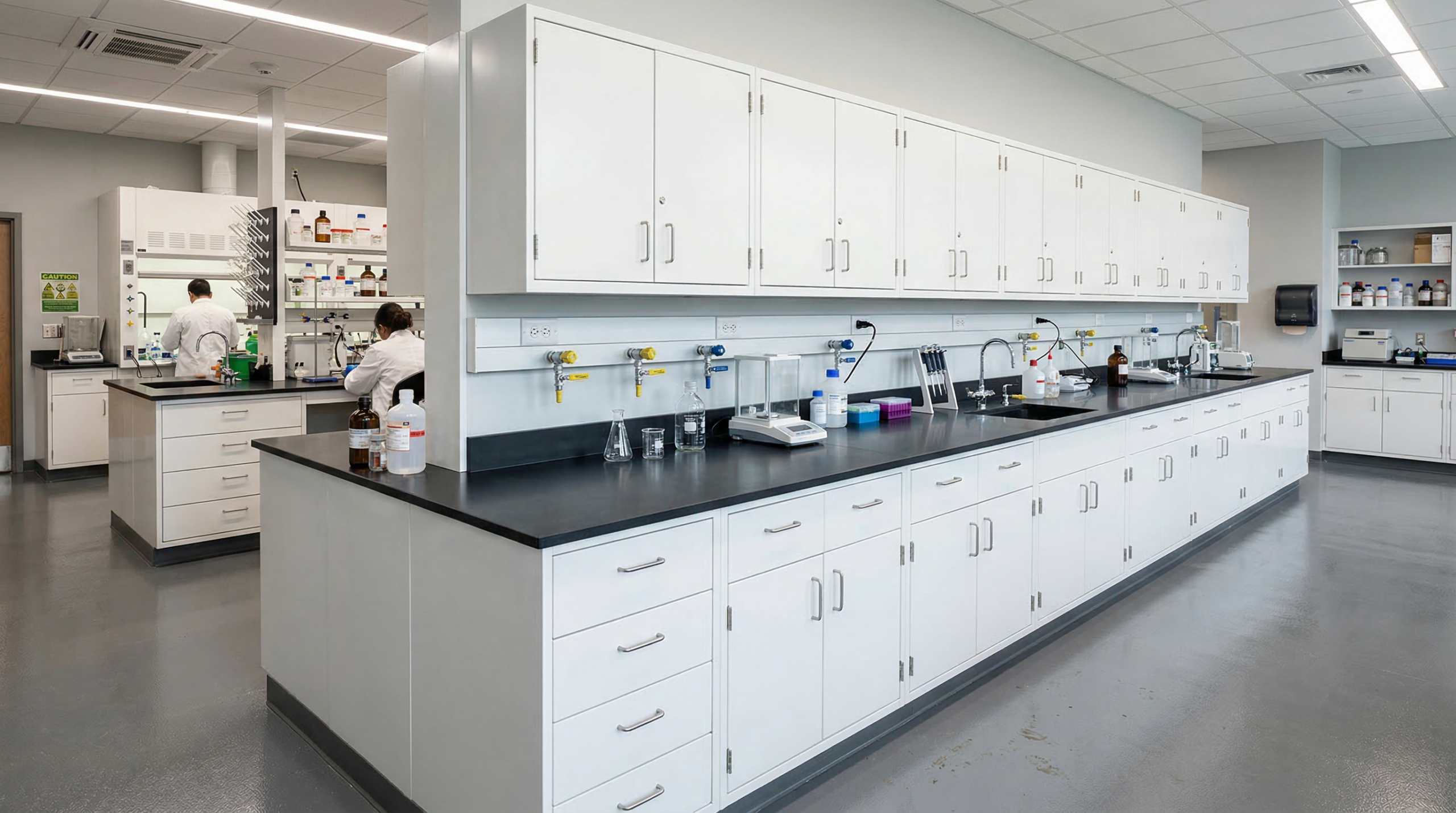
Modular laboratory furniture systems use standardized, interchangeable components, including bench frames, work surfaces, storage units, shelving, and utility connections, that can be assembled, disassembled, and reconfigured without specialized construction labor.
The modular approach has gained significant momentum as research organizations face accelerating change in project scope, team size, and equipment requirements. A modular lab that takes a day to reconfigure replaces a fixed lab that takes months to renovate. For an in-depth look at modular bench capabilities, see Modular Lab Benches: Customizable Options for Dynamic Workspaces.
- Rapid reconfiguration: Modular benches and cabinets can be rearranged in hours or days, not months. This allows facilities to respond quickly to new research programs, team changes, or equipment acquisitions.
- Lower lifecycle cost: While the initial purchase price of modular furniture may be comparable to fixed casework, the total cost of ownership over 20 years is typically 30 to 50 percent lower because reconfigurations do not require demolition, custom fabrication, or extensive utility rework.
- Scalability: Modular systems grow with your organization. Additional bench sections, storage units, and workstation components can be added incrementally without replacing existing furniture.
- Utility flexibility: Advanced modular systems include overhead service carriers and quick-disconnect utility connections that allow power, gas, and data to follow the furniture when it moves.
- Sustainability: Modular furniture generates less construction waste during reconfigurations and can be relocated to new facilities, extending its useful life well beyond a single building.
Fixed vs Modular Lab Furniture: A Direct Comparison
To make the fixed vs modular lab furniture decision with confidence, it helps to compare the two approaches across the criteria that matter most to laboratory operations. The following comparison addresses the factors that facilities planners and lab managers most frequently evaluate.
- Installation timeline: Fixed casework requires 4 to 6 months from order through installation. Modular furniture can be delivered in 4 to 8 weeks and installed in 1 to 3 days for a typical lab room.
- Reconfiguration cost: Fixed lab reconfiguration costs $50,000 to $150,000+ per room. Modular reconfiguration costs $5,000 to $15,000 per room with minimal disruption.
- Load capacity: Fixed casework typically provides higher static load ratings due to wall and floor anchoring. Modular systems have improved significantly and now offer load ratings of 250 to 500+ pounds per linear foot, sufficient for most laboratory instruments.
- Chemical resistance: Both fixed and modular systems are available with identical countertop material options (epoxy, phenolic, stainless steel, ceramic). Chemical resistance depends on the work surface, not the casework type.
- Service life: Well-maintained fixed casework lasts 20 to 30 years in place. Modular furniture lasts 20+ years and can serve multiple configurations and even multiple facilities over its lifetime.
- Space efficiency: Fixed casework maximizes use of irregular spaces. Modular systems work best in rooms with standard dimensions and clearances.
When to Choose Fixed Casework
Fixed lab casework remains the right choice for specific laboratory scenarios where permanence, maximum load capacity, or custom spatial requirements outweigh the need for flexibility.
- Dedicated instrument rooms: Spaces that house a single, permanently installed instrument (such as an ICP-MS, GC-MS, or NMR spectrometer) and are unlikely to change function for a decade or more.
- Client-facing and showroom labs: Facilities where aesthetic appearance is a priority and the lab layout is unlikely to change frequently.
- Extreme load applications: Workstations supporting very heavy equipment (1,000+ pounds) that requires wall or floor anchoring for stability and safety.
- Irregular room geometries: Spaces with non-standard dimensions, angles, or structural obstructions that require truly custom-fitted furniture.
- Regulatory-mandated configurations: Some regulated environments (BSL-3 containment labs, certain pharmaceutical clean rooms) may require specific fixed installations to meet certification requirements.
When Modular Laboratory Furniture Is the Clear Winner
For the majority of modern laboratory applications, modular furniture provides a better return on investment and a more adaptable workspace. The following scenarios strongly favor the modular approach. For a comprehensive overview of modular system capabilities, see Modular Laboratory Systems: The Flexible Solution for Dynamic Research Needs.
- Multi-program research facilities: Labs that serve rotating research teams, grant-funded projects, or academic programs with changing curriculum needs benefit enormously from furniture that reconfigures quickly.
- Growing organizations: Startups, expanding CROs, and institutions adding new departments need furniture that scales incrementally without major capital expenditure.
- Leased facilities: Organizations in leased spaces can take modular furniture with them when they move, protecting their investment. Fixed casework stays with the building.
- Renovation projects: When upgrading an existing lab, modular furniture can be installed around ongoing operations with minimal disruption. For practical guidance on upgrading existing lab spaces, see Retrofitting Your Lab: How to Upgrade Outdated Laboratory Furniture.
- Budget-conscious projects: When total cost of ownership over 15 to 20 years is the primary financial metric, modular systems consistently outperform fixed casework due to lower reconfiguration and adaptation costs.
Making the Right Choice for Your Laboratory
The fixed vs modular lab furniture decision does not have to be binary. Many successful laboratory facilities use a hybrid approach, installing fixed casework in permanent instrument rooms and using modular furniture in general-purpose lab spaces, teaching areas, and flex zones. This strategy provides the stability of fixed systems where it matters most while preserving flexibility everywhere else.
Start your decision process by mapping each room in your facility against the criteria outlined above. Identify which spaces require permanence and which will benefit from adaptability. Consider your five-year and ten-year facility plans. If you anticipate growth, reorganization, or technology changes, weight your design toward modular systems.
Genie Scientific helps laboratory managers and facilities planners evaluate their specific requirements and design furniture solutions that balance permanence, flexibility, and budget. Whether you choose fixed casework, modular systems, or a strategic hybrid, the goal is the same: create a laboratory environment that supports your team’s best work today and adapts seamlessly to whatever comes next.