
Why Collaborative Lab Workstations Matter in Modern Research
Collaborative lab workstations have become essential infrastructure for research organizations that depend on cross-functional teamwork. As scientific disciplines converge and projects grow more complex, the days of isolated, single-user bench setups are fading. Today’s labs need furniture systems that bring researchers together, streamline communication, and support simultaneous workflows without compromising safety or efficiency.
The shift toward multi-user lab spaces reflects a broader transformation in how science gets done. Interdisciplinary projects in genomics, materials science, and pharmaceutical development require chemists, biologists, engineers, and data analysts to work side by side. When your workstations are designed for collaboration, you remove physical barriers that slow down knowledge sharing and problem-solving.
According to facilities planning experts at Genie Scientific, organizations that invest in purpose-built collaborative workstations consistently report faster project timelines and improved researcher satisfaction. The right furniture layout does more than save space. It creates an environment where high-performance teams can thrive.
Key Design Principles for Multi-User Lab Spaces
Designing effective research team workstations requires balancing openness with personal workspace boundaries. A successful multi-user lab space allows researchers to interact freely while maintaining enough individual territory to handle sensitive samples, instruments, and documentation. Here are the principles that guide effective collaborative lab design.
- Shared central zones: Create communal work surfaces at the center of the lab where team members can gather for shared procedures, sample preparation, or group analysis. These zones should be easily accessible from multiple workstations.
- Individual perimeter stations: Position personal workstations along the perimeter walls, giving each researcher dedicated bench space for focused tasks that require concentration or isolation from group activity.
- Clear sightlines: Arrange furniture so team members can see and signal each other without leaving their stations. Open sightlines improve communication and support real-time coordination during experiments.
- Flexible utility access: Route electrical, gas, and data connections through overhead service carriers or raised floor channels so workstations can be reconfigured without costly infrastructure changes.
- Adequate clearance: Maintain a minimum of 60 inches between opposing bench fronts. In high-traffic multi-user areas, 72 inches is preferred to allow safe passage when researchers are seated or working with equipment.
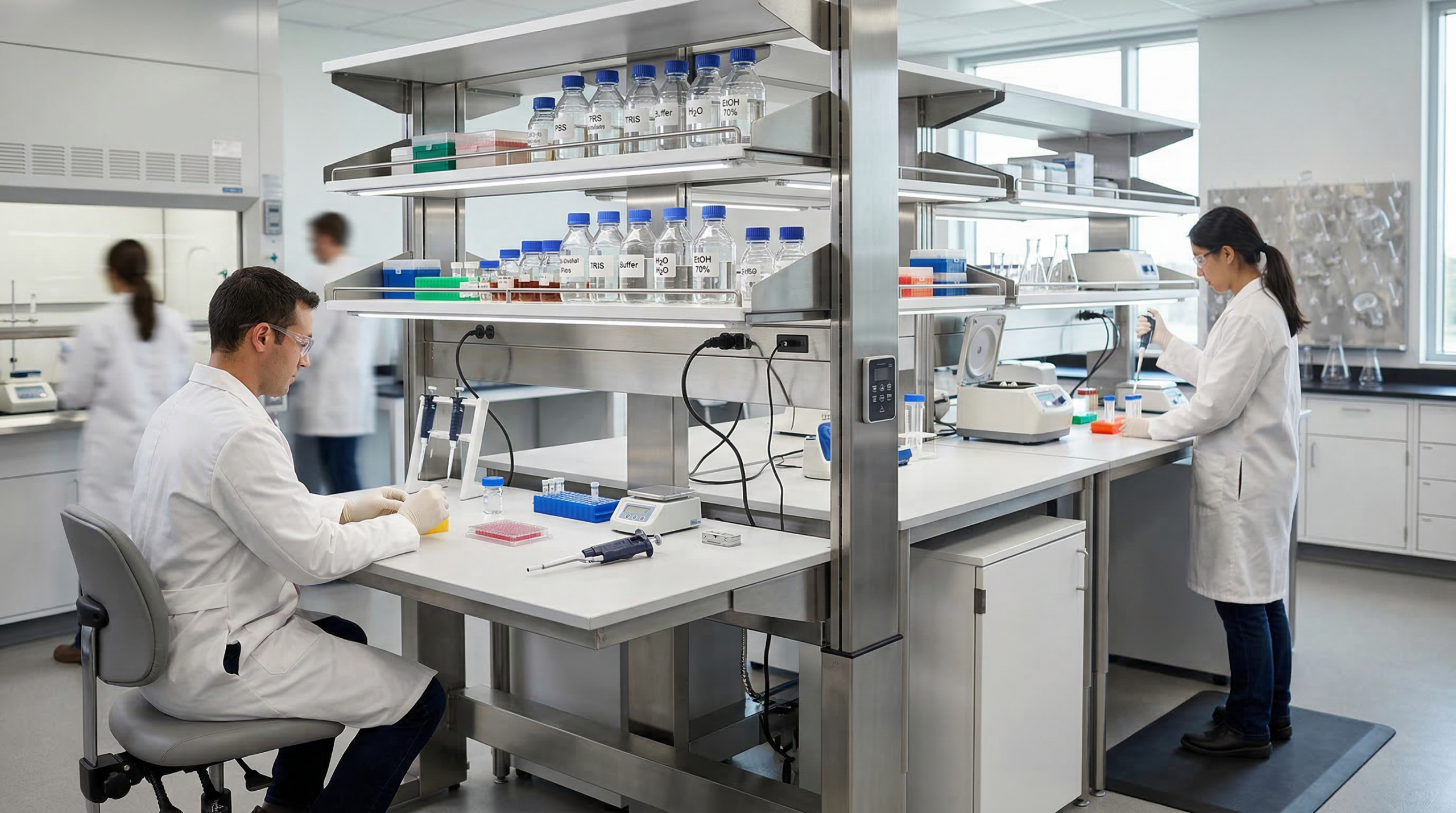
Collaborative Lab Workstations: Furniture Configurations That Work
Choosing the right furniture configuration for collaborative lab workstations depends on your team size, workflow patterns, and the types of instruments in use. There is no one-size-fits-all layout, but several proven configurations consistently deliver strong results for multi-user research environments.
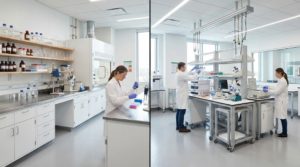
Island-style bench clusters position four to six researchers around a central work surface. This arrangement maximizes face-to-face interaction and works well for teams that share instruments, reagents, or analytical equipment. Island clusters are especially popular in teaching labs and quality control environments where mentoring and peer review happen continuously.
L-shaped and U-shaped workstation pods give individual researchers more personal bench space while still keeping team members within arm’s reach. These configurations work well when each researcher runs independent experiments that occasionally require collaboration or shared resources. For a deeper dive into furniture ideas that support teamwork, see Creating a Collaborative Laboratory Space: Furniture Ideas for Teamwork.
Peninsula benches extend from the wall and create natural gathering points where two or three researchers can work opposite each other. This setup preserves wall space for shelving and overhead cabinets while encouraging collaboration at the bench front.
Ergonomics and Adjustability for Diverse Research Teams
Research teams include people of different heights, working preferences, and physical needs. Collaborative lab workstations must accommodate this diversity to prevent fatigue, repetitive strain injuries, and productivity loss. Ergonomic design is not optional; it is a core requirement for any multi-user lab space.
Height-adjustable lab benches allow each researcher to set their work surface at the optimal level, whether they prefer to sit or stand. This flexibility is especially valuable in shared workstations where multiple people use the same bench during different shifts. Learn more about ergonomic bench solutions in Height-Adjustable Lab Benches: Improving Comfort and Productivity.
- Anti-fatigue mats at standing workstations reduce lower-back strain during long procedures.
- Adjustable monitor arms and keyboard trays keep digital workstations aligned with each researcher’s preferred posture.
- Task lighting at individual stations prevents eye strain without creating glare for neighboring workstations.
- Footrests and ergonomic lab chairs with lumbar support accommodate seated work at fixed-height benches.
- Cable management systems keep power cords and data lines off the bench surface, preventing tripping hazards in shared spaces.
Modular Systems for Evolving Research Team Workstations
Research priorities shift. Teams grow, shrink, and reorganize. The most effective collaborative lab workstations are built on modular systems that can adapt without requiring a full renovation. Modular lab furniture allows you to add bench sections, swap out storage components, and reconfigure entire workstation clusters as project needs evolve.
Modular benches with standardized connection points snap together in different configurations. A linear four-person bench can be reconfigured into two L-shaped pods in a matter of hours, without tools or specialized labor. This adaptability is especially valuable for contract research organizations and academic labs that support rotating project teams.
For a comprehensive look at modular bench options, explore Modular Lab Benches: Customizable Options for Dynamic Workspaces. Investing in modular infrastructure from the start saves significant time and budget compared to replacing fixed casework every time your team structure changes.
- Interchangeable shelving, drawer units, and pegboard panels let researchers customize their personal workspace within a shared system.
- Mobile bench carts and rolling cabinets provide supplemental work surface and storage that can follow team members between stations.
- Quick-disconnect utility connections allow benches to be moved and reconnected to power, gas, and data without shutting down neighboring stations.
- Standardized bench widths (typically 24, 30, or 36 inches deep) ensure that components from different configurations remain interchangeable.
Technology Integration in Multi-User Lab Spaces
Modern collaborative lab workstations must support a growing array of digital tools, from data acquisition systems and instrument control software to electronic lab notebooks and video conferencing for remote collaborators. Thoughtful technology integration keeps these tools accessible without cluttering the bench surface.
Built-in power strips with USB charging ports at each station eliminate the tangle of extension cords that plague poorly planned multi-user labs. Overhead service panels that carry ethernet, power, and compressed air connections down to individual stations keep the bench surface clear for hands-on work.
- Integrated monitor mounts position screens at eye level without consuming valuable bench space.
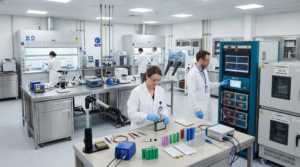
- Shared display screens at the center of workstation clusters allow teams to review data, protocols, and imaging results together in real time.
- Wireless instrument connectivity reduces cable clutter and simplifies workstation reconfiguration.
- Network-connected smart power strips allow facility managers to monitor energy consumption and shut down idle equipment remotely.
Planning Your Collaborative Lab Workstation Investment
Investing in collaborative lab workstations is a strategic decision that affects research output, team morale, and facility longevity. The most successful lab renovation and build-out projects start with a clear understanding of how research teams actually work, not just how many people need bench space.
Start by observing your team’s daily workflows. Map out where collaboration happens naturally, where bottlenecks form, and where researchers struggle with inadequate space or poor furniture ergonomics. This observational data will drive better furniture selections than any catalog specification sheet.
Work with a lab furniture partner that understands the intersection of research workflow and workspace design. Genie Scientific offers consultation services that help facilities planners translate research requirements into workstation configurations that support both current operations and future growth.
The labs that consistently produce high-impact research are the ones that treat their physical workspace as a competitive advantage. By designing collaborative lab workstations with intention, modularity, and ergonomic precision, you give your research teams the infrastructure they need to do their best work.