
In any laboratory setting, ensuring a safe and efficient work environment is paramount. Fume hoods are essential in protecting laboratory personnel from hazardous fumes, vapors, and airborne contaminants. That brings up the question: ducted vs. ductless fume hoods? These systems play a crucial role in maintaining air quality, supporting scientific research, and complying with stringent safety regulations.
However, when it comes to selecting the right fume hood, lab managers and engineers often face a key decision: ducted vs. ductless. Each system offers unique advantages, but understanding their key differences, pros, cons, and ideal applications can be challenging for lab managers and engineers.
In this article, we’ll explore the fundamentals of ducted vs. ductless fume hoods, providing a detailed comparison to help you choose the best option for your specific lab needs. Whether you’re designing a new lab or upgrading your current system, we’ll break down the factors you should consider to ensure optimal safety, efficiency, and cost-effectiveness.
Understanding Fume Hoods
A fume hood is one of the most vital pieces of safety equipment in any laboratory. Its primary purpose is to protect personnel from inhaling hazardous fumes, vapors, or particulate matter by capturing and containing airborne contaminants before they can spread throughout the lab.
By drawing contaminated air away from the user and filtering or exhausting it safely, fume hoods help maintain both air quality and regulatory compliance—key concerns for any facility handling chemicals or volatile substances.
While the core function remains the same, fume hoods can differ significantly in how they manage and remove hazardous air. The two main types—ducted and ductless—achieve containment in very different ways:
- Ducted fume hoods channel contaminated air outside the building through a fixed duct system.
- Ductless fume hoods, on the other hand, use advanced filtration technologies to clean the air and recirculate it back into the lab.
Understanding the differences is critical when it comes to ducted vs. ductless for ensuring both safety and operational efficiency in modern laboratory environments.
Ducted Fume Hoods – Key Features and Benefits
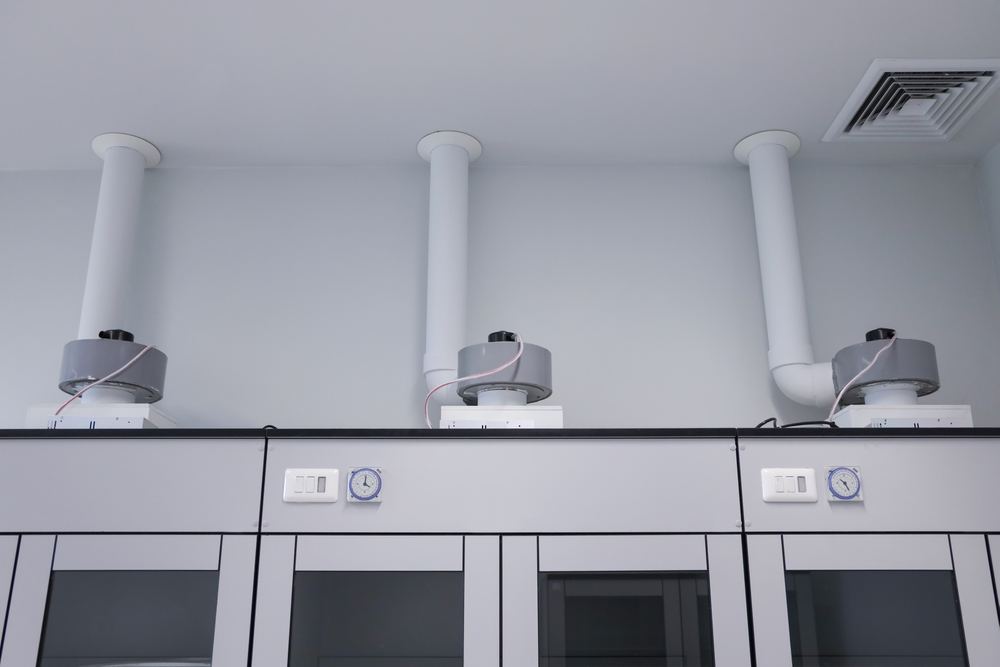
Ducted fume hoods are the traditional standard for laboratories that handle hazardous or high-volume chemical processes. These systems are connected to a building’s ductwork, which channels contaminated air through an exhaust system and releases it safely outdoors.
Because the air is not recirculated into the lab, ducted hoods offer the highest level of containment and safety for volatile, toxic, or corrosive substances.
How Ducted Fume Hoods Work
A blower or fan draws contaminated air from the workspace through an adjustable sash opening. The air then moves through internal baffles designed to maintain uniform airflow before it’s vented outside via a dedicated duct system.
This setup ensures that harmful vapors and particulates are continuously removed, protecting both personnel and the integrity of ongoing experiments.
Pros
- Superior containment and safety: Ideal for working with toxic gases, acids, solvents, and volatile compounds.
- Broad chemical compatibility: Can safely handle a wide range of substances without filtration limitations.
- Consistent performance: Airflow is maintained at a steady rate regardless of workload or filter saturation.
- Long-term reliability: With proper maintenance, ducted hoods deliver durable, consistent performance over many years.
Cons
- Complex installation: Requires permanent ductwork, exhaust fans, and potentially structural modifications.
- Higher operational costs: Continuous air exchange increases energy use for heating, cooling, and ventilation.
- Limited flexibility: Once installed, ducted systems are not easily relocated or reconfigured.
For facilities prioritizing maximum safety and regulatory compliance—such as chemical research, pharmaceutical production, and academic chemistry labs—ducted fume hoods remain the gold standard.

Ductless Fume Hoods – Key Features and Benefits
Ductless fume hoods (also known as recirculating fume hoods) are designed for flexibility, efficiency, and ease of installation. Unlike their ducted counterparts, these systems don’t vent air outdoors. Instead, they pull contaminated air through specialized filtration media—typically activated carbon and HEPA filters—before recirculating clean, purified air back into the laboratory.
This closed-loop design makes ductless hoods a smart solution for labs that prioritize mobility, energy savings, or space efficiency.
How Ductless Fume Hoods Work
Air is drawn into the hood through the sash opening and passes through multiple layers of filters. These filters trap chemical vapors, particulates, and odors before releasing purified air back into the workspace. Depending on the substances used, filters can be customized to target specific contaminants—ensuring compliance with laboratory safety standards when properly maintained.
Pros
- Easy installation: No ductwork or building modifications required—plug in and start working.
- Lower energy consumption: Since conditioned air remains inside the lab, ductless hoods reduce HVAC loads.
- Portable and flexible: Can be relocated or reconfigured as lab layouts evolve.
- Eco-friendly: Recirculating air minimizes exhaust emissions and reduces environmental impact.
Cons
- Limited chemical compatibility: Not suitable for high concentrations of volatile or toxic compounds.
- Ongoing maintenance: Filters require regular inspection and replacement to maintain performance.
- Restricted application range: Best suited for light-duty work or educational settings with low-risk materials.
For labs focused on energy efficiency, adaptability, and localized containment, ductless fume hoods deliver a practical and sustainable alternative—provided the right filtration is matched to the application.
Comparing Fume Hoods—Ducted vs. Ductless
Choosing between a ducted and ductless fume hood isn’t simply a matter of preference—it’s a decision that affects safety, energy efficiency, and long-term operational costs. Understanding how each system performs across key criteria can help determine which is best suited to your lab’s workflow and chemical profile.
Airflow and Safety
- Ducted fume hoods offer maximum containment, constantly expelling hazardous air from the lab through an external exhaust. This makes them the preferred choice for environments that handle aggressive solvents, acids, or toxic gases.
- Ductless hoods, while effective for light to moderate chemical use, rely on filtration rather than exhaust. Their performance depends heavily on the correct filter type, proper maintenance, and adherence to manufacturer safety guidelines.
Additional Reading: Decoding Laboratory Fume Hood Design: Best Practices for Safety
Installation and Maintenance
- A ducted system requires professional installation, complete with ductwork, blowers, and potentially significant structural integration. Maintenance primarily involves fan and sash inspections but tends to be less frequent once installed.
- By contrast, ductless systems are plug-and-play, requiring minimal setup. However, their filters must be inspected and replaced regularly—a recurring cost that keeps the system performing safely and efficiently.
Cost Analysis
- When considering total cost of ownership, ducted fume hoods generally have higher upfront and operating costs due to energy consumption from HVAC systems and exhaust fans.
- Ductless systems are more economical to install and cheaper to run daily, as they conserve conditioned air and reduce energy draw. Over time, though, filter replacement costs should be factored into budget planning.
Environmental Impact
- From a sustainability standpoint, ductless fume hoods are the greener option, reducing emissions and energy loss.
- Ducted hoods, on the other hand, continuously exhaust conditioned air outdoors—increasing HVAC demand but ensuring full chemical removal.
In short, ducted hoods prioritize safety and versatility, while ductless hoods emphasize efficiency and flexibility. The right choice of ducted vs. ductless fume hoods depends on your lab’s hazard profile, budget, and operational goals.
Additional Reading: The Evolution of Laboratory Fume Hoods: What’s New

Ideal Applications for Ducted vs. Ductless Fume Hoods
Every laboratory has unique needs based on the types of chemicals used, workflow intensity, and available space. Understanding where each system performs best ensures that your investment aligns with both safety requirements and operational efficiency.
When to Choose a Ducted Fume Hood
Ducted fume hoods are ideal for high-risk or high-volume laboratories where safety and compliance are non-negotiable. Because these systems vent contaminants directly outdoors, they are suitable for environments dealing with toxic gases, corrosive acids, or volatile organic compounds (VOCs).
Common applications include:
- Chemical research and development facilities
- Pharmaceutical and biotechnology labs
- Industrial and materials testing labs
- University chemistry departments and teaching labs
- Any environment where multiple users or processes generate hazardous vapors
In these settings, a ducted fume hood provides the highest level of protection, ensuring clean air, consistent performance, and compliance with regulatory standards.
When to Choose a Ductless Fume Hood
Ductless fume hoods are best suited for low- to moderate-risk applications where chemical use is limited or highly specific. Their compact, self-contained design makes them ideal for labs that value mobility, energy efficiency, and cost control.
Common applications include:
- Quality control and sample preparation labs
- Educational and training laboratories
- Research labs handling small quantities of benign chemicals
- Temporary or modular lab setups
- Facilities looking to reduce environmental impact
For these labs, ductless fume hoods provide an eco-friendly, flexible, and cost-effective solution—as long as filtration requirements are carefully matched to the substances in use.

Genie Scientific: Your Single Source Solution for Fume Hoods and Lab Equipment
When creating a safe, efficient, and fully functional laboratory, selecting the right fume hood is an important part of the process. Making the ducted vs. ductless decision is where Genie Scientific steps in as a trusted, single-source partner for lab managers and engineers.
Comprehensive Lab Solutions
Genie Scientific provides both ducted and ductless fume hoods, tailored to meet the specific needs of each laboratory. Whether you require high-capacity ducted systems for chemical-heavy environments or flexible ductless units for light-duty applications, Genie ensures you get the right solution for your unique workflow.
Full-Service Offering
Beyond fume hoods, Genie’s expertise extends across the entire lab ecosystem. From lab design and equipment sourcing to installation, maintenance, and compliance consulting, Genie supports labs every step of the way—simplifying procurement and ensuring seamless integration of all systems.
Expert Guidance
Lab managers and engineers can rely on Genie’s scientific expertise to make informed decisions. Their team assists in evaluating risks, selecting appropriate equipment, and optimizing layouts to maximize safety, efficiency, and productivity.
Customization and Support
Every laboratory is different, which is why Genie offers customized solutions to fit specific space, budget, and operational requirements. Continuous support and maintenance services ensure that your fume hoods—and all other lab equipment—perform reliably over the long term.
With Genie Scientific as your partner, labs gain more than just equipment; they gain a holistic solution for creating a safe, efficient, and future-ready laboratory environment.

Conclusion
Choosing between ducted vs. ductless fume hoods is a critical decision that impacts laboratory safety, efficiency, and compliance. Ducted systems offer unparalleled protection and versatility, making them ideal for high-risk environments dealing with hazardous chemicals. In contrast, ductless hoods provide flexibility and cost-effectiveness, suitable for labs handling low-risk substances or those with space and budget constraints.
Consulting with an expert like Genie Scientific ensures you select the right system for your laboratory’s needs. By understanding the unique advantages and limitations of each system, lab managers and engineers can make informed choices that align with their specific operational needs and safety standards.
For comprehensive guidelines on fume hood safety and performance standards, refer to the Occupational Safety and Health Administration’s (OSHA) Laboratory Safety Chemical Fume Hoods QuickFacts: OSHA Fume Hood Safety Guidelines.